

A Singapore employer has identified the right foreign specialist for an important hire. The candidate is ready, the business wants a start date, and the employment contract is nearly complete. Then the practical question arrives: how should the employer prepare the file, check eligibility, submit the Employment Pass application, respond to follow-up queries and plan for renewal later?
This is where a structured Employment Pass application process in Singapore matters. An EP application is not just a form sent to the Ministry of Manpower, it is an employer workflow linking role design, salary planning, evidence, submission, onboarding and future compliance. The size of the EP population also shows why disciplined process matters. MOM recorded 204,300 Employment Pass holders in June 2026, according to its official Foreign Workforce Numbers.
Why Employers Need a Clear EP Application Process
It is tempting to treat the pass as the final administrative step after recruitment. That creates avoidable pressure. If the role is scoped too broadly, the salary is poorly benchmarked, or the candidate’s documents do not support the application, the employer may only discover the weakness after the preferred hire has already accepted.
A better approach is to treat the EP as part of the hiring plan from the start. That means checking the role, salary, documentation and likely COMPASS position before the offer is fully locked in. It also means keeping a clear record for later issuance, onboarding and renewal.
The pass is part of workforce planning
MOM’s figures reflect a large professional foreign workforce, not a niche administrative category. For employers hiring specialist talent, pass planning needs to sit alongside the wider hiring decision. A delayed application can affect the start date, payroll setup, project delivery and relocation timing.
That is especially relevant for SMEs and overseas companies building a Singapore team. A lean HR function may be able to handle a straightforward case, but may not have capacity to review every supporting document, assess the role against COMPASS or track future threshold changes.
Practical rule: Assess the EP before the offer is finalised, not after the candidate has resigned and booked a relocation.
The right workflow starts with the role, tests the candidate against current requirements, and identifies future renewal risks. It then moves through evidence preparation, submission, response management and expiry monitoring.
Employer Checklist, What the EP Application Process Covers
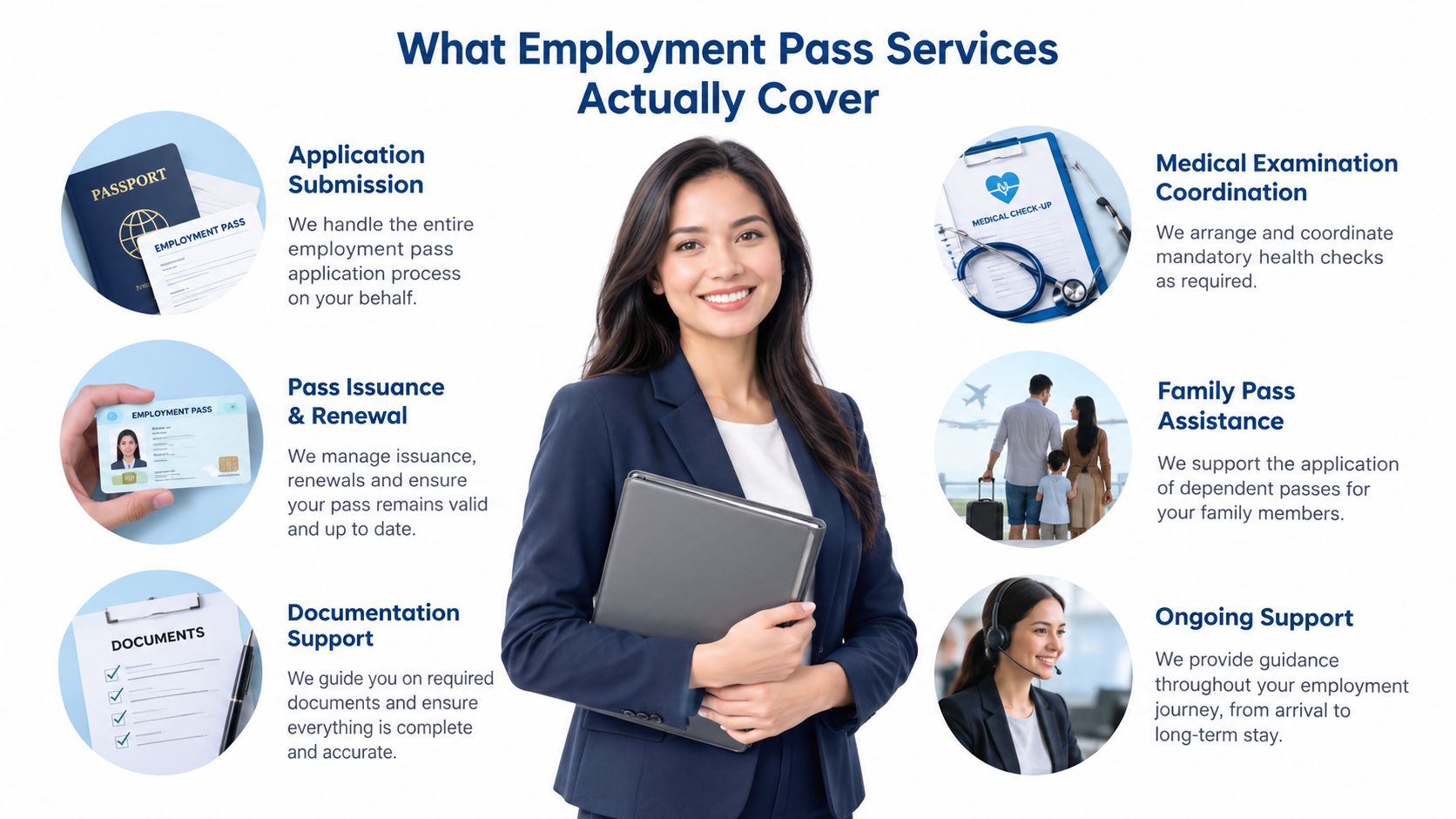
The EP process should be understood as managed employer-side preparation and coordination, not just form submission. Whether handled internally or with outside support, the employer needs a workflow for role information, candidate documents, application data, submission administration and communication during the process.
The first stage is application preparation. This includes checking that the job description reflects the actual role, reviewing the proposed fixed monthly salary, and identifying the information needed for the application. A sound process tests the role before the candidate becomes commercially committed. It also gives the employer a chance to adjust the hiring plan if the original structure creates avoidable eligibility or COMPASS concerns.
Preparation before submission
Document collation normally brings together several information streams:
- Candidate evidence: Identity documents, qualifications and any supporting records relevant to the declared professional background.
- Employment information: Job title, duties, fixed monthly salary, employment terms and the business reason for the hire.
- Company information: Details about the Singapore employer, its activities and the role within the organisation.
- Assessment support: Information relevant to the applicable COMPASS criteria and any specialist-role considerations.
The application is then submitted through MOM’s EP eService. The work does not end once the application is lodged. The employer still needs to monitor the case, coordinate responses to MOM queries, identify missing information and keep the hiring team informed about next steps.
Renewals need their own calendar
Renewal management is often underestimated because the first application feels like the main event. In practice, the employer needs a forward-looking record of pass expiry, salary position, role changes, company changes and evidence used in the original submission. A renewal review that starts shortly before expiry leaves little room to redesign a role or correct a documentation gap.
The useful analogy is recurring compliance management. The value lies in maintaining an organised process over time, not only in completing one application. In-house HR can retain ownership of the employment decision and employee relationship, while an internal coordinator or external adviser manages the application workflow, document control and administrative sequencing.
How the Employment Pass Fits Within Singapore’s Work Pass System
The Employment Pass sits within Singapore’s work-pass system for higher-skilled foreign professionals, including professional, managerial, executive and specialist appointments. It should not be selected simply because the job title sounds senior. The employer needs to match the pass to the role, salary, candidate profile and sector, then confirm the current MOM requirements.
Other passes serve different hiring situations. An S Pass is designed for eligible skilled roles under a quota and levy framework. Work Permits cover specified groups of migrant workers in approved sectors and carry their own employer obligations. Entrepreneurial, training and other specialist immigration routes have different purposes again.
The structural difference for employers
MOM confirms that an Employment Pass has no foreign worker levy and no quota requirement in its key facts guidance.
That does not make the EP automatic. It changes where the employer’s attention goes. Instead of managing levy headroom or sector quota availability, the employer needs to focus on:
- Salary: The proposed fixed monthly salary must satisfy the applicable qualifying requirement.
- COMPASS: Unless an applicable exemption applies, the candidate must meet the points-based framework.
- Evidence: The application must accurately connect the candidate, role, salary and employer information.
- Timing: The hiring plan must allow for processing, possible queries and pass issuance before work begins.
Choose the likely pass before the offer
A pass choice made too late can distort the hiring process. An employer may identify a role that cannot reasonably support EP requirements, then discover that an alternative pass carries quota or levy implications. That can affect budget, workforce mix and start-date assumptions.
The sound decision is to assess the likely pass during role design. The EP is often the relevant route for a foreign specialist or senior professional, but the employer should not infer eligibility from seniority alone. The application still turns on current rules and the evidence submitted.
Eligibility, Salary Planning and Documents Employers Should Prepare
The current EP salary position needs to be separated from announced future changes. For current applications, the general qualifying salary is S$5,600, while the financial-services threshold is S$6,200. MOM has announced that the figures will rise to S$6,000 for most sectors and S$6,600 for financial services for new applications from 1 January 2027, with the new thresholds applying to renewals from 1 January 2028, as stated in the MOM announcement on the changing work-pass framework.
That future change matters now because hiring decisions often run ahead of the application date. An offer agreed late in 2026 may still result in a new EP application after the 2027 threshold takes effect. A mid-senior candidate may have substantial experience but still fail the salary requirement if the proposed package remains below the applicable line.
Build the file around the actual role
A practical document pack normally includes:
- Identity and qualification records, including the candidate’s passport information and relevant educational or professional evidence.
- Employment details, including the job description, reporting line, proposed salary and employment terms.
- Company information, including the employer’s business details and the context for creating or filling the role.
- COMPASS support, including information relevant to salary, qualifications, diversity, sector contribution and any specialist-role treatment that applies.
- Consistency checks, comparing names, dates, job duties, salary details and company information across the complete submission.
The job description deserves particular attention. It should describe the work the candidate will actually perform, not a generic title chosen to make the application appear more senior. Salary, responsibilities and candidate evidence need to tell the same story.
Employers deciding how to manage the application workflow can use the Employment Pass and HR setup service as the primary reference point when comparing internal handling against external support. The decision should reflect internal capacity, application complexity and the consequences of a delayed start.
The Employment Pass Application Timeline, From Preparation to Approval
The application timeline begins before the online form. Employers need time to benchmark the role, confirm the salary, collect candidate records and check that company information is ready. A rushed submission may be quick to file, but still create delays if MOM needs clarification or if the evidence does not align.
MOM states that online applications are typically processed or updated within 10 business days. For an overseas company with no Singapore-registered office, the EP application must be submitted by a local sponsor, and most such cases are processed within 6 weeks, according to the official MOM application guidance.
A usable employer timeline
The table below translates MOM’s published processing guidance into employer actions. The timing is typical rather than a promise, and follow-up queries or incomplete information can change the sequence.
| Stage | Employer action | Typical timing |
|---|---|---|
| Pre-application preparation | Confirm the role, salary, candidate records and company information | Before submission |
| Online submission | Complete and submit the EP application through the EP eService | After preparation is complete |
| MOM processing | Monitor the application and respond to any request for information | Typically within 10 business days for online applications |
| Overseas company planning | Use a local sponsor where there is no Singapore-registered office and allow additional lead time | Most such cases processed within 6 weeks |
| In-principle approval | Review the approval details and organise the next administrative steps | After approval |
| Pass issuance and onboarding | Complete issuance arrangements and align the confirmed start date with payroll and HR records | Before work begins |
Start dates should follow the pass plan
The employment contract may contain a proposed start date, but the employer should not treat that date as operationally fixed until the pass process supports it. Payroll onboarding, access provisioning, relocation arrangements and project allocation should be sequenced around the expected approval and issuance stages.
Business-critical and project-based hires need a contingency plan. If the start date slips, the hiring manager should know which project milestones move, who covers the interim work and how the candidate will be kept informed. The employer should also avoid allowing work to begin while the application is still pending.
COMPASS Checks and How Employers Can Reduce Rejection Risk
COMPASS is not a substitute for the qualifying salary requirement. An EP candidate generally needs 40 points to pass COMPASS, unless an exemption applies, and must also satisfy the applicable salary requirement. A candidate who falls below the qualifying salary is not eligible for an EP regardless of the COMPASS score, as stated in MOM’s C1 salary benchmark guidance.
Under C1, salary at the 65th percentile of local PMET salaries in the relevant sector earns 10 points, while salary at the 90th percentile earns 20 points. Employers therefore need to distinguish between the qualifying salary gate and the COMPASS points awarded for salary positioning under C1.
What the 2026 COMPASS details mean in practice
For C1 salary benchmarks, MOM states that the current benchmark set applies to new applications from 1 January 2026 to 31 December 2026 and to renewals of EPs expiring from 1 July 2026 to 30 June 2027, according to the same MOM C1 benchmark guidance.
Separately, MOM states that the updated Shortage Occupation List applies to new and renewal EP applications from 1 January 2026, as explained in its COMPASS C5 skills bonus guidance.
For employers hiring in engineering, semiconductors, pharmaceuticals, logistics and technology, the practical question is not only whether a role is difficult to fill. The role needs to be tested against the relevant occupation treatment, qualifications, salary position and the employer’s wider COMPASS profile. A shortage-occupation route may improve the assessment position for an eligible specialist role, but it does not remove the salary requirement.
Reduce risk before submission
A disciplined pre-submission review should ask:
- Is the salary defensible? The fixed monthly salary should be assessed against the current qualifying requirement and the relevant sector benchmark.
- Is the role specific enough? Duties, seniority and specialist content should accurately reflect the appointment.
- Are the qualifications usable? The employer should confirm that the declared credentials fit the current recognised-qualification rules.
- Does the role need redesign? A change in duties, seniority, salary structure or candidate profile may produce a more coherent COMPASS case.
- Are renewals phased properly? Existing employees and new hires should be reviewed against the announced future thresholds before renewal pressure appears.
Hiring decision: If a role only works on paper because the salary is below the qualifying line, the application should not be submitted first and questioned later. The role or package needs to be resolved before the offer becomes difficult to change.
DIY Handling Versus Employer Support
DIY handling is reasonable when the employer has a Singapore-based HR owner, a familiar role, complete documents and enough time to manage follow-up. It becomes less attractive when the company is hiring its first foreign professional, operating without a Singapore-registered office, coordinating relocation or building a team while also setting up payroll and HR processes.
The right comparison is usually about scope rather than convenience. Some employers only need submission support. Others need a broader process that connects role review, documentation, onboarding and renewal planning.
What employers should compare
| Model | Usually suits | Questions to ask |
|---|---|---|
| DIY | An experienced internal HR or operations team with complete records | Who checks COMPASS exposure, tracks queries and owns renewals? |
| Application support | A company needing help with a defined EP submission | Does the scope include document review, submission, follow-up and issuance coordination? |
| Broader HR support | A lean SME or foreign employer building its Singapore operation | Does the support connect pass planning, payroll and HR setup? |
A first-time overseas applicant should plan for more than form completion. The absence of a Singapore-registered office means a local sponsor is needed for the application, and the employer may also need support with role documentation, onboarding sequencing and broader employment setup. Renewals deserve equal attention because the employee’s salary, role and the policy environment may have changed since the first application.
For employers that want process support tied to the wider employment setup, the most relevant commercial page is PathSource’s Employment Pass and HR setup service.
Renewal Reviews and 2027 Planning
Renewals should not be left to the final weeks before expiry. The employer needs enough time to reassess salary, role scope, reporting lines, business activity and the supporting evidence that may have changed since the initial filing.
The current-versus-2027 salary distinction is especially important here:
- Current thresholds: S$5,600 for most sectors and S$6,200 for financial services.
- From 1 January 2027 for new applications: S$6,000 for most sectors and S$6,600 for financial services.
- From 1 January 2028 for renewals: the same higher thresholds apply to EP renewals.
That means employers planning 2027 hiring cannot rely on today’s salary floor if the new application will only be submitted after the threshold changes. It also means employers with existing EP holders should review renewal-sensitive roles ahead of 2028 rather than waiting until the pass is close to expiry.
Planning the Next EP Application With More Confidence
Employers should treat an Employment Pass application as part of the hiring plan, not as paperwork attached to the end of recruitment. The role needs a clear business purpose, the salary needs to be tested before the offer is finalised, and the evidence needs to be gathered while the candidate remains engaged in the process.
The sequencing is simple:
- Scope the appointment: Define the duties, seniority and specialist requirements accurately.
- Test the salary: Check the current qualifying requirement and the relevant sector benchmark.
- Prepare the evidence: Keep candidate, company and role information consistent across the submission.
- Submit with time in hand: Build the published processing window into the start date and payroll plan.
- Review the next pass cycle: Consider the announced 2027 change for new applications and the 2028 change for renewals before making long-term offers.
This gives hiring managers a better basis for deciding whether a role should proceed as designed, be restructured, or be supported through a broader HR setup plan.
Where the hire is important and internal capacity is limited, employers can review PathSource’s Employment Pass and HR setup service to assess whether external support is commercially worthwhile.
PathSource Consulting supports employers with founder-led specialist and executive recruitment, Employment Pass and work-pass coordination, payroll outsourcing and HR setup for Singapore teams. Employers can discuss a planned hire, a new Singapore operation or a renewal-sensitive workforce requirement by visiting PathSource Consulting.