

A Series B fintech in Singapore is hiring its first regional head of compliance while replacing a finance manager who has resigned. Both roles sit with the same hiring team, but treating them as one recruitment exercise creates immediate problems. The compliance search needs market mapping, discreet outreach and a credible story about regional scope. The finance replacement needs speed, continuity and a clear understanding of the departing manager's responsibilities.
That distinction is the foundation of effective talent acquisition in Singapore. Hiring leaders must decide which market to access, which sourcing channel fits the role, how much employer brand exposure is appropriate, whether internal recruiters have enough specialist reach, and whether work-pass or payroll considerations could change the offer. The advice below is for employers making mid-senior and specialist hires, where a generic vacancy post rarely solves the core problem.
A Strategic View of Talent Acquisition in Singapore
The fintech's two vacancies have different definitions of success. The regional compliance leader may need to build a function that doesn't yet exist, influence stakeholders across markets and operate with incomplete internal benchmarks. The finance manager, by contrast, has an established position, known reporting lines and a more visible handover risk.
A sensible hiring plan starts by separating those requirements before a job description is written. For the growth role, the employer must define the capability it needs to add. For the backfill, the employer must identify which responsibilities are essential, which can be redesigned and which skills belonged only to the previous incumbent.
The trade-offs behind every specialist hire
Singapore employers generally face four connected choices:
- Speed versus candidate quality: A fast process matters, but rushed screening can produce candidates who meet the title requirement without handling the actual complexity of the role.
- In-house control versus specialist reach: Internal teams understand the organisation, while a specialist recruiter may have deeper access to passive candidates in a narrow market.
- Local sourcing versus international hiring: A local shortlist may simplify onboarding, while an international search can widen access to scarce experience but introduce work-pass and relocation considerations.
- Employer brand exposure versus confidentiality: A public campaign can create reach, but confidential leadership or replacement searches may require direct and controlled outreach.
The right answer depends on the vacancy, not on a permanent preference for internal hiring or agency support. A founder-led search can work well for a highly trusted appointment, but it can also become slow when the founder is balancing fundraising, operations and candidate conversations. An internal team can run a disciplined process, but it needs an agreed scorecard and enough time to engage candidates who aren't actively applying.
Practical rule: The hiring channel should follow the scarcity and sensitivity of the role, not the organisation's habit.
A strong intake meeting should therefore settle the role's purpose, business impact, must-have experience, acceptable adjacent backgrounds, decision-makers, compensation positioning and work-pass route before sourcing begins. That discipline improves the quality of the conversation with candidates and gives the employer a defensible basis for assessing fit.
The Singapore Hiring Market in 2026
Singapore's labour market remains active, but the headline picture doesn't tell employers where hiring will be difficult. In the second quarter of 2026, total employment increased by 11,400, marking the nineteenth consecutive quarter of growth, while vacancies exceeded unemployed persons at 1.48 vacancies per unemployed person in June 2026. The Ministry of Manpower's second-quarter 2026 labour-market report also recorded 68,600 vacancies in June 2026, down from 73,300 in March, with 31,700 entry-level PMET vacancies, representing 45.3% of all vacancies.
Those figures point to two realities at once. Employers still have meaningful hiring demand, yet qualified candidates in professional and technical roles can remain selective. A broad vacancy count doesn't reveal whether the relevant candidates are available in regulatory compliance, regional product, treasury, software development or another specialised function.
| Indicator | Recent Range | What It Means for Hiring |
|---|---|---|
| Total employment change | Increased by 11,400 in 2Q 2026 | Employers are hiring in a market that continues to expand |
| Vacancies per unemployed person | 1.48 in June 2026 | Qualified candidates may have several credible options |
| Total vacancies | 68,600 in June 2026 | Demand remains substantial even after a quarterly decline |
| Entry-level PMET vacancies | 31,700, or 45.3% of vacancies | Professional and technical hiring remains an important part of the market |
Why generic funnels miss specialist candidates
A job advert measures application activity, not access to the people an employer needs. Senior specialists may be employed, cautious about moving, bound by confidentiality or unconvinced that a public description reflects the role's real authority. They often need a specific reason to take a call, such as regional scope, a new mandate, access to decision-makers or a clearer growth path.
Labour turnover also supports a more deliberate approach. In the second quarter of 2026, the average monthly recruitment rate was 1.4% and the resignation rate was 1.0%, according to the Ministry of Manpower's second-quarter 2026 labour-market report.
That pattern suggests measured candidate movement, even while hiring continues. Employers should expect more passive-candidate engagement, more careful evaluation of the offer and greater sensitivity to process quality. Generic sourcing funnels underperform because the most relevant candidates are often already working and assessing the employer as closely as the employer assesses them.
Growth Hiring Versus Backfill Hiring
Growth hiring creates capability. Backfill hiring restores continuity. Combining them in one talent acquisition plan is a common mistake because the roles carry different levels of definition, urgency and risk.
A growth role may support a new market, a newly funded function or an expansion into a capability the employer has never held internally. The hiring manager may not have a previous incumbent to use as a benchmark. The search therefore needs more time spent on market mapping, adjacent backgrounds and the employer's explanation of why the role exists.
A backfill role has a different centre of gravity. The business already knows what the position touches, where decisions sit and what the previous person delivered. Speed and operational continuity matter, but the employer still needs to test whether the old job design remains appropriate.

Different searches need different operating choices
| Decision area | Growth hiring | Backfill hiring |
|---|---|---|
| Role definition | Built around future capability and business expansion | Based on existing responsibilities, with room to improve the design |
| Sourcing | Broader market mapping and passive-candidate outreach | Targeted replacement search and relevant adjacent profiles |
| Assessment | Tests judgement in an evolving environment | Tests continuity, delivery and ability to take over quickly |
| Employer brand | Explains the opportunity, mandate and future scope | Reinforces stability, team context and the reason for the vacancy |
| Work-pass planning | May be central where the capability is scarce locally | Usually assessed against a known role and immediate business need |
| Process risk | The company may not recognise the right profile immediately | Internal stakeholders may over-specify the previous incumbent |
Growth hiring often justifies a more consultative search because the employer is selling a mission that candidates cannot validate through a standard job description. Backfill hiring can use a narrower funnel, but only after the hiring manager agrees which requirements are genuinely essential.
The cost of treating both as one vacancy type
A growth search can fail when the employer expects a ready-made candidate who has already performed an identical job in an identical organisation. A backfill can fail when the team spends too long debating an ideal profile while the vacancy disrupts daily operations.
The distinction also changes employer-brand exposure. A public campaign can help explain a new growth mandate, but it may be inappropriate for a sensitive replacement, especially where the departure has not been communicated widely. Work-pass planning follows the same logic. A growth role may need international sourcing from the beginning, while a backfill may first justify a local search before the employer considers cross-border options.
Sourcing Channels and How to Match Them to the Role
No sourcing channel is universally efficient. Job boards create visibility, but visibility alone doesn't guarantee specialist relevance. LinkedIn outreach can identify passive candidates, although response depends on the message, the employer's credibility and the precision of the target profile. Referrals can provide trust and context, but they are limited by the networks employees already hold.
The channel decision should start with four questions:
- How narrow is the required experience?
- How senior or confidential is the mandate?
- How quickly does the employer need a credible shortlist?
- Can the internal team evaluate specialist candidates confidently?
| Role type / hiring scenario | Best-fit primary channel | Secondary channel | Typical time to shortlist |
|---|---|---|---|
| Operational and logistics roles at established market rates | LinkedIn and the employer’s ATS pipeline | Employee referrals and targeted advertising | Relatively short when requirements are clear |
| Mid-senior specialist roles below senior leadership level | Specialist contingent recruitment | Direct outreach and referrals | Moderate, depending on niche depth |
| Senior product, commercial or technical leadership | Retained executive search or embedded search | Direct founder or leadership outreach | Longer, because passive-candidate engagement requires discretion |
| Confidential replacement or business-critical appointment | Retained search or a tightly managed specialist assignment | Carefully selected referrals | Variable, with confidentiality taking priority over volume |
Channel fit matters more than fee comparison
A contingent specialist agency can suit a defined mid-senior mandate where the employer needs reach without committing to a retained search structure. Retained executive search is more appropriate when the shortlist must be carefully mapped, the role is confidential or the candidate pool is largely passive. Embedded recruitment, sometimes described as Recruitment-as-a-Service, suits a scale-up that needs ongoing capacity but isn't ready to build a complete internal talent acquisition function.
An internal team should measure channel quality through practical signals rather than application volume. The most useful indicators include:
- Shortlist quality: How many presented candidates meet the actual success criteria?
- Weeks to shortlist: How long does it take to reach credible profiles, not merely applications?
- Candidate drop-off: At which stage do qualified candidates stop engaging?
- Counter-offer exposure: How often do employed candidates receive a competing internal offer?
- Hiring-manager rework: How often does the brief change after sourcing begins?
Employers needing specialist reach can review the role of specialist recruitment agencies in Singapore and a recruitment agency in Singapore against the likely scarcity, confidentiality and evaluation burden. The important comparison is not agency fee versus internal cost. It is the cost of an incomplete shortlist, a delayed appointment or an offer made to a candidate who cannot handle the role's actual demands.
Choosing Between In-House, Specialist and Embedded Search
The decision between internal recruitment and external support should be made against the next twelve months of hiring, not the next vacancy alone. An internal team tends to work well when hiring volume is predictable, hiring managers can define and assess roles consistently, and the employer brand already creates relevant inbound interest.
Specialist contingency recruitment makes sense when the employer has a narrow mandate and needs additional market reach without committing to a retained search. It is particularly useful when the internal team understands the business but lacks networks in a specific function, industry or seniority band.

Four criteria for making the call
Forecasted hiring volume comes first. A business expecting a steady flow of similar roles may benefit from strengthening internal capability. A business with occasional specialist searches may get more value from external expertise.
Average role seniority changes the operating model. Senior and confidential roles demand more market mapping and stakeholder management. They shouldn't be treated as ordinary requisitions just because the organisation already has recruiters.
Employer-brand maturity determines how much inbound interest the company can generate. A familiar employer with clear career messaging may fill more roles directly. A new Singapore entity or lesser-known business may need a specialist to explain the opportunity and reach candidates who aren't applying.
The type of vacancy is equally important. Backfill roles often benefit from an internal process built around speed and continuity. Net-new roles may need external challenge because the hiring team hasn't yet developed a reliable profile or benchmark.
Embedded search is the middle path for a scale-up that has outgrown founder-led hiring but isn't ready to create a full talent acquisition function. An external recruiter works alongside internal stakeholders, helping with role intake, sourcing, candidate evaluation and process discipline for a defined period. Employers assessing this model can also review Workforce Launchpad as a structured embedded recruitment option.
For senior and confidential mandates, employers can assess the scope of executive search firms in Singapore by asking how they build the market map, who conducts candidate conversations and how the firm explains its recommendations. The assigned consultant's judgement matters because senior candidates often assess the quality of the search process before they assess the opportunity.
The most expensive model is the one that gives the hiring team activity without a decision-ready shortlist.
The right arrangement can also change over time. A company may use specialist search for a first technical leader, establish repeatable hiring criteria and later bring similar appointments in-house. Conversely, an internal team may retain routine roles while using external search for a confidential leadership hire.
Work Pass and CPF Planning for Specialist Hires
Work-pass eligibility and CPF treatment belong in offer design, not at the final administrative stage. A foreign candidate may appear suitable until salary, age, sector, fair-consideration obligations and the relevant pass route are assessed. Growth hiring deserves this review before the role enters the market, while a backfill hire may require it before the employer commits to a replacement timeline.
For Employment Pass planning, the current minimum qualifying salary is S$5,600 for most sectors and S$6,200 for financial services, with the threshold rising progressively with age. From 1 January 2027, those thresholds are scheduled to rise to S$6,000 and S$6,600 respectively, so employers planning offers across that boundary should model both the current and upcoming figures. Verify the position through MOM's Employment Pass eligibility guidance before making an offer, then review the employer-side Employment Pass application steps before setting the candidate's start date.
MOM also states that employers must fairly consider jobseekers, while the Employment Pass salary benchmark is tied to the top one-third of local PMET salaries by age. The Employment Pass guidance for employers belongs in the pre-shortlist review, particularly for senior or specialist foreign hires.
A practical pre-offer sequence
- Define the candidate's work location, role and sector. Sector affects the salary threshold, while age affects the progressive benchmark.
- Check salary viability before final interviews. A role that cannot support the applicable benchmark needs redesign before it reaches offer stage.
- Record fair-consideration steps. Keep the role requirements, interview criteria and assessment decisions clear and consistent.
- Separate EP planning from S Pass planning. The routes have different eligibility conditions, quotas and cost implications, so they should not be treated as interchangeable.
- Explain the assumptions early. Candidates should know what the employer expects from the work-pass process and how timing may affect onboarding.
CPF planning requires the same discipline. Employers must contribute CPF for Singapore Citizens and Singapore Permanent Residents earning more than S$50 per month. If an employee earns above S$50 but not more than S$500 per month, there is no employee share, but the employer still pays the employer share, as set out in the CPF contribution obligations.
From 1 January 2026, CPF rates for Singapore Citizens and qualifying Singapore Permanent Residents vary by age and total wages. For first- and second-year Singapore Permanent Residents, full employer and employee rates may apply only after CPF Board approves a joint application. Use the CPF Board's 2026 contribution table when modelling employment cost.
Compare local and foreign candidates on more than base salary. Model CPF treatment, work-pass feasibility and the time required for compliant onboarding before finalising the shortlist.
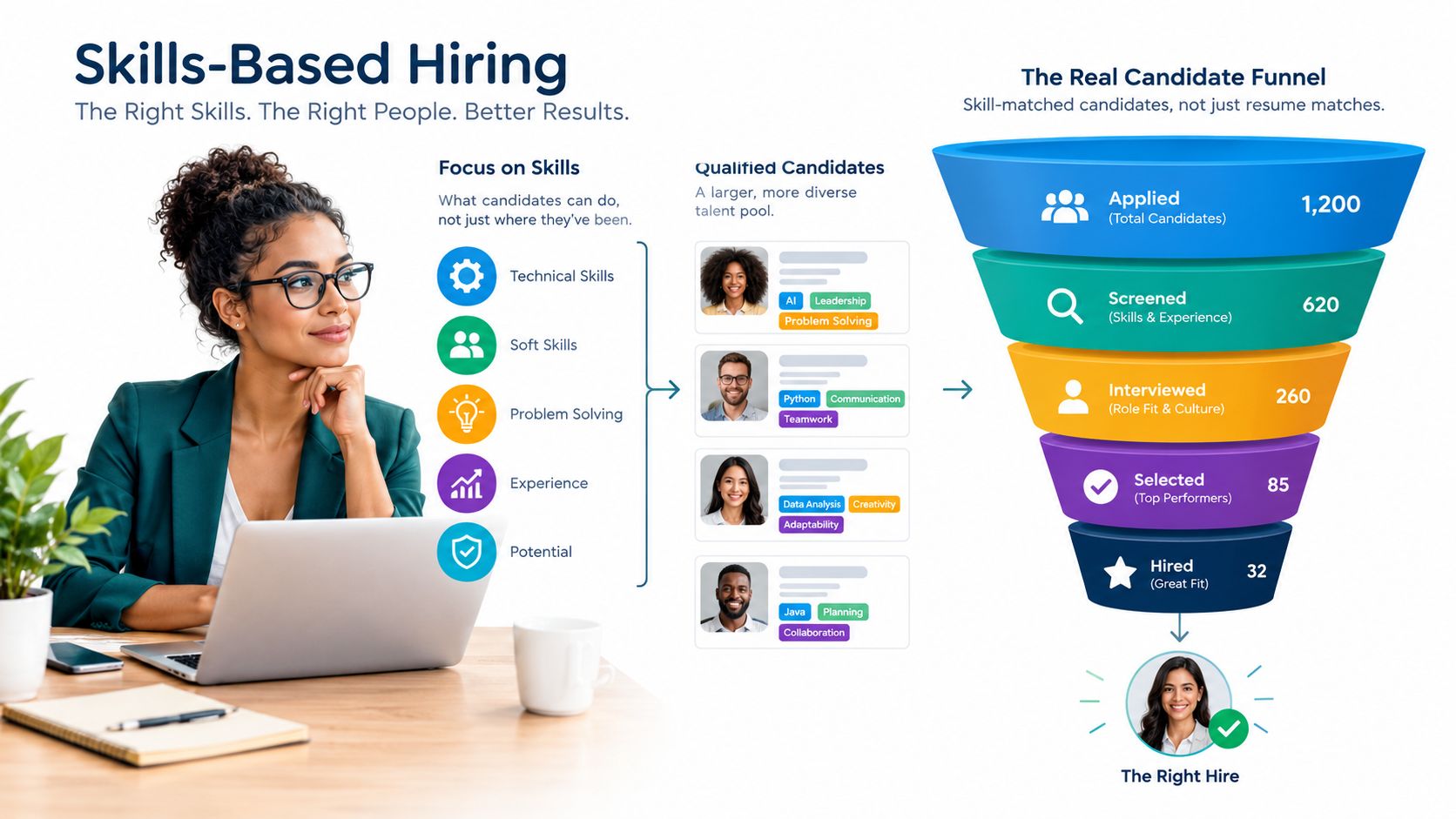
Skills-Based Hiring and the Real Candidate Funnel
Removing a degree requirement can improve access, but it doesn't automatically create more qualified candidates. The decisive question is whether the funnel is restricted by credential screening or by genuine scarcity of industry, regulatory, technical or regional capability.
MOM's 2025 Job Vacancies report found that academic qualifications weren't the main determinant in 79.6% of vacancies, up from 67.1% in 2017. At the same time, PMET vacancies unfilled for at least six months rose to 16.0% in 2025, even as overall long-term vacancies eased to 17.1%. These figures, reported in MOM's 2025 job-vacancies data, show why skills-based hiring needs operational detail rather than a broad policy statement.
Where skills-first hiring genuinely helps
Skills-based filters can widen access when a degree is acting as a proxy for capability rather than a genuine requirement. This may apply to emerging digital roles, junior-to-mid technical appointments and candidates with strong portfolios or transferable experience. It can also support internal reskilling, where the employer already has evidence of performance and only needs to assess readiness for a broader remit.
The approach is less effective when a role requires specific regulated experience, regional market knowledge, complex stakeholder management or a rare technical background. Removing the academic requirement won't create a larger pool of candidates who have already handled those conditions.
Hiring managers should test the constraint directly:
- If qualified candidates are rejected at application stage because of credentials, redesigning the filter may improve access.
- If candidates reach interview but lack the required capability, the problem sits in sourcing depth or role positioning.
- If internal employees can learn the missing skills, the employer should compare reskilling with external hiring.
- If the role is business-critical and highly specialised, the employer needs a broader market map, not just a shorter list of formal requirements.
Hard-to-fill PMET occupations include software developers, data scientists, civil engineers, and applications and systems programmers. That context matters because the hiring manager may be competing for a narrow capability even after removing a degree requirement.
Skills-first hiring works when employers change the evidence they accept. It doesn't work when the same narrow experience requirements remain hidden under a more inclusive job description.
The strongest process replaces credential shortcuts with structured evidence. Candidates can be assessed through relevant work samples, behavioural interviews, technical discussions and examples of decisions made in comparable environments. The employer should document which signals predict success in the specific role, rather than treating “skills-based” as a reason to reduce assessment discipline.
Putting It Together and Next Steps
A practical talent acquisition plan in Singapore can begin with a short internal review. The employer doesn't need a large transformation programme, but it does need decisions in the right order.
Start with the vacancy's purpose
The first decision is whether the role is growth hiring or backfill hiring. A growth role needs a capability narrative, a market map and a realistic view of adjacent backgrounds. A backfill needs a continuity plan, a confirmed handover profile and a decision on whether the previous role design still serves the business.
The hiring manager should then write a one-page scorecard covering outcomes, essential experience, trainable skills, disqualifiers and the evidence required at interview. This prevents the role from expanding into an unrealistic list of preferences once candidates begin to appear.
Match the channel to the scarcity
Internal sourcing can remain the primary route where the employer has adequate reach and a credible inbound brand. Specialist support becomes more defensible where candidates are passive, the function is narrow or the search requires confidentiality. Embedded search suits a company that has recurring hiring demand but lacks the capacity or systems for a full internal function.
The employer should review channel performance using shortlist quality, time to credible profiles, candidate drop-off and hiring-manager rework. Application volume is a weak substitute for those measures.
Complete the employment-cost check early
Before a foreign candidate reaches final offer, the employer should verify the relevant Employment Pass salary threshold, age-banded benchmark and fair-consideration requirements. The team should also model CPF obligations for Singapore Citizens and Permanent Residents, using current CPF guidance rather than a historical payroll assumption.
A 30-day operating plan can look like this:
- Week one: classify every open role as growth or backfill, then agree the scorecard with the hiring manager.
- Week two: select the sourcing channel based on scarcity, seniority, confidentiality and internal capacity.
- Week three: start targeted outreach and review candidate feedback for gaps in the role story, salary positioning or process speed.
- Week four: assess shortlist quality, candidate drop-off and work-pass feasibility before extending an offer.
The employer should also decide who owns candidate communication, interview feedback and work-pass coordination. A strong search can still lose candidates when hiring managers delay decisions or provide inconsistent explanations of the role.
PathSource Consulting supports employers with founder-led executive and specialist recruitment, embedded recruitment, Employment Pass and work-pass application support, payroll outsourcing and HR setup for Singapore teams. Employers planning a mid-senior or specialist hire can bring the role brief, current pipeline and work-pass questions to the PathSource Consulting team for a practical discussion. The team can help assess whether the requirement calls for targeted specialist search, executive search or embedded recruitment support.