

A foreign company can incorporate in Singapore, secure its first office and identify a senior hire, then discover that the employment operation isn't ready for the start date. The candidate may meet the published Employment Pass salary requirement, but that alone doesn't guarantee approval. Payroll may not yet distinguish taxable benefits from ordinary salary, and no one may have tested how the hire affects CPF, tax reporting or the employer's workforce plan.
That is why HR setup for foreign companies in Singapore should be treated as a workforce-planning exercise rather than a bundle of incorporation documents. For an overseas company preparing its first Singapore hire, the practical sequence connects the initial employing entity, role design, work-pass strategy, contracts, payroll, CPF governance and year-end reporting. When those elements are designed together, founders can make more credible hiring decisions and avoid discovering a compliance gap after a candidate has already accepted an offer.
Why First-Hire HR Planning Often Falters for New Singapore Entities
This article is intended as a practical checklist for overseas companies preparing their first Singapore hire. A typical founder wants to move quickly. The Singapore entity is established, a regional business leader has identified a senior specialist, and the hiring manager assumes the remaining work is a contract and an Employment Pass application. The salary is set above the published EP qualifying level, so the team treats approval as a formality.
That approach creates risk at the point where speed matters most. The candidate must pass more than one gate, and the job must be described accurately enough to support the declared occupation, seniority and salary. A generic description copied from a global template may not explain why the role requires the proposed compensation or how it fits the Singapore operation.
The salary threshold is only the beginning
MOM's Employment Pass eligibility guidance makes clear that a qualifying salary isn't an approval guarantee. The salary is benchmarked by age and sector against the upper tier of local PMET salaries, and the employer must generally assess COMPASS eligibility as well. Unless an exemption applies, the candidate needs at least 40 COMPASS points.
The employer also needs to support the application with a coherent role profile, a salary rationale, evidence of local labour-market consideration and compliance with Fair Consideration Framework advertising requirements. Qualifying employers may be exempt from mandatory MyCareersFuture advertising, including employers with fewer than 10 employees, but all employers must still follow MOM's fair hiring practices. The application should make sense as one employment decision, not as disconnected information assembled at the end.
Incorporation doesn't create an operating HR function
A newly incorporated entity may have a registered address and a bank account, but still lack:
- A role architecture: Job title, occupation, seniority, reporting line and compensation should align.
- A pass decision: The business should know whether the role is local, EP-sponsored, S Pass-related, redesigned or delayed.
- A payroll classification model: Worker status, residency, remuneration components, benefits and CPF treatment need to be captured at onboarding.
- Document controls: Contracts, payslips, supporting calculations and employment records should be retained in an organised way.
- Ownership: Someone must be accountable for monthly payroll, statutory submissions and work-pass monitoring.
Practical rule: The hiring plan should be tested before the binding offer is made, not after the preferred candidate has resigned from an existing role.
The trade-off is straightforward. A founder who spends more time on workforce design at the outset may slow the first hiring conversation slightly, but gains a clearer view of start-date risk and total employment administration. A founder who treats HR as post-incorporation paperwork may appear faster, while shifting uncertainty into the candidate's onboarding and the company's compliance process.
The core issue isn't a lack of documents. It's the absence of a connected operating model. The Singapore team needs a role that can be hired, a pass strategy that can be defended, and payroll controls that can process the employee correctly once work begins.
The Correct Order for Establishing HR and Workforce Compliance
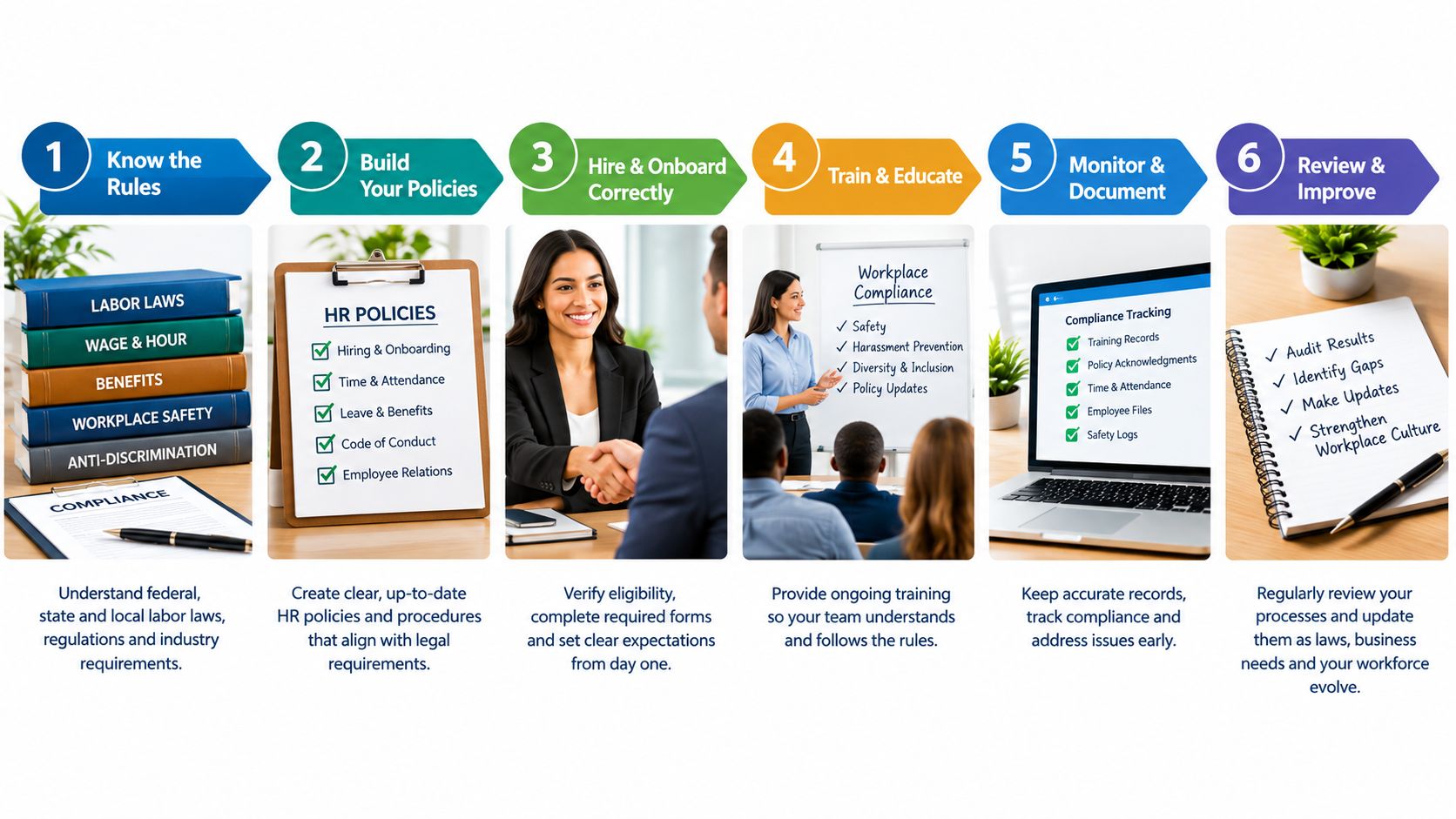
A company can be incorporated and ready to sign contracts while its first hire still has no workable pass strategy, role definition or employment process. Treat incorporation as the legal starting point, not as proof that the workforce is ready. The initial employing entity, work-pass assessment, payroll setup and statutory reporting each solve a different problem, and the employer should connect them in that order.
Start with the business requirement, not the candidate's nationality. Define the work, seniority, reporting relationship and compensation logic. Then compare local hiring, EP sponsorship, an S Pass route where applicable, compensation redesign or a delayed appointment. After that, build the payroll record and reporting controls that will support the eventual hire. This sequence exposes start-date and approval risks before they become promises to a preferred candidate.
Test the pass route before making the offer
For a foreign professional, the first gate is the EP qualifying salary. The threshold is benchmarked by age and sector against the upper tier of Singapore local PMET salaries. A single published figure therefore cannot serve as a universal hiring benchmark.
The second gate is COMPASS. MOM's official pass guidance sets out the wider work-pass framework, and the employer should use the Self-Assessment Tool to test COMPASS. Unless an exemption applies, the candidate must obtain at least 40 points.
EP qualifying salary and COMPASS's C1 salary criterion are separate tests. COMPASS salary points benchmark the candidate against local PMETs in the same sector, and the relevant salary level changes materially with age. An offer may clear the entry threshold while providing a weak basis for approval once the full assessment is considered.
MOM identifies exemptions including a fixed monthly salary of at least S$22,500, certain overseas intra-corporate transferees and roles lasting one month or less. Assess each exemption against the actual facts. A job title or corporate structure does not establish eligibility by itself.
Make a documented choice for each role
Use the following questions to keep workforce planning connected to compliance:
- Can the role be filled locally? Assess suitable local capability on its own merits instead of treating foreign sponsorship as the default.
- Does the proposed foreign hire fit the EP framework? Test salary, age, sector, occupation and COMPASS position before the offer becomes binding.
- Would an S Pass route be appropriate? Review current requirements, workforce implications and applicable constraints. An S Pass is not automatically interchangeable with an EP.
- Should the role be redesigned? A revised reporting structure, scope or compensation architecture may create a more coherent hiring case.
- Should hiring wait? Delaying the appointment can be more responsible than promising a start date that depends on an uncertain pass outcome.
Under announced changes, the EP minimum salary is set to rise from S$5,600 to S$6,000 and the S Pass threshold from S$3,300 to S$3,600, as set out in MOM's work-pass framework guidance. These higher salary thresholds apply to new applications from 1 January 2027 and to relevant renewals from 1 January 2028. They are future changes, not figures that should automatically be treated as the current rule. Confirm the applicable threshold and effective timing before making an offer.
Record the role profile, salary rationale, local labour-market availability and, where applicable, MyCareersFuture advertising compliance. A specialist partner can support preparation and coordination. PathSource Consulting's guide to Employment Pass and HR setup in Singapore can help structure that work, but the company remains responsible for the employment decision.
Work-pass support is effective when it informs workforce planning. It cannot repair a poorly defined role after the hiring promise has been made.
Building Controlled Payroll and CPF Governance from Day One
Payroll should be designed before the first employee joins. A new employer needs more than a bank file and a spreadsheet. It needs a controlled monthly process that records how each worker is classified, paid and reported.
At onboarding, the payroll record should capture:
- Tax position: Singapore tax treatment must not be inferred solely from nationality or work-pass status.
- Residency and CPF status: Citizenship or permanent-resident status affects the contribution analysis.
- Work-pass information: Pass type, validity details and employment dates should be maintained where relevant.
- Remuneration components: Salary, allowances, bonuses, benefits and benefits-in-kind should be separated rather than placed in one undifferentiated total.
- Supporting documents: The employment contract, payslips and calculations should be retained for audit and reconciliation.
Make each payroll cycle auditable
Each monthly cycle should reconcile gross pay to net pay, statutory deductions, employer CPF obligations where applicable and salary disbursement records. The person reviewing the run should be able to explain changes from the previous cycle, including new joiners, leavers, bonuses, benefits and corrections.
This is also where contract and payroll design meet. If an employment agreement describes a benefit but payroll has no field for it, year-end reporting becomes a manual reconstruction exercise. If a foreign employee's work-pass status is treated as proof of tax residency, the payroll record may carry an incorrect assumption into the tax process.
Control point: Payroll totals, CPF records and the IR8A dataset should be reconciled before year-end close, not assembled separately after the reporting deadline approaches.
Prepare year-end reporting continuously
Employers must report remuneration and CPF contributions through Form IR8A and, where applicable, Appendix 8A or 8B. Employers participating in IRAS's Auto-Inclusion Scheme submit employment-income data electronically by 1 March 2027 for YA2027, as set out in the IRAS explanatory notes for Form IR8A and related appendices. Non-AIS employers still need to prepare the required forms for employees by the applicable deadline, even though the submission route differs.
The employer should give employees a structured opportunity to review taxable benefits before the dataset is finalised. Common omissions include benefits-in-kind, incorrect CPF treatment and incomplete remuneration records. A pre-close review can identify inconsistencies while the underlying payroll data is still accessible.
For a lean entity, payroll outsourcing can provide processing capacity without requiring a full internal payroll function. Payroll outsourcing support from PathSource Consulting is one option for employers that need monthly processing, salary disbursement coordination and support with statutory payroll obligations. Outsourcing can assist with execution, but it does not transfer statutory employer accountability. The key selection criterion isn't merely whether a provider can run payroll. It is whether the process has clear data ownership, review points, escalation routes and year-end reconciliation.
Common CPF Mistakes That Increase Employer Cost and Risk
A new company can have accurate salaries and still submit incorrect CPF contributions if it classifies employees too broadly. Contributions apply to employees earning more than S$50 per month, while the applicable rates depend on citizenship or permanent-resident status, age and wages. Using one percentage for every employee removes the information required for a correct calculation.
For Singapore citizens and third-year-onwards permanent residents earning monthly wages above S$750, the employer contribution rates from 1 January 2026 are:
| Employee age band | Employer rate | Total employer and employee rate |
|---|---|---|
| 55 and below | 17% | 37% |
| Above 55 to 60 | 16% | 34% |
| Above 60 to 65 | 12.5% | 25% |
| Above 65 to 70 | 9% | 16.5% |
| Above 70 | 7.5% | 12.5% |
The applicable rates and contribution conditions are set out in the CPF Board employer contribution guidance. Use the table as a starting point, then check the employee's full circumstances, including wage rules and applicable ceilings.
Keep statutory rates as dated payroll settings
CPF rates can change between contribution periods, so a payroll file should carry an effective date rather than only a current percentage. The CPF Board has announced that from 1 January 2027, the total contribution rate for employees above 55 to 60 is scheduled to rise from 34% in 2026 to 35.5%, comprising 16.5% from the employer and 19% from the employee, as set out in the CPF Board announcement on new contribution rates.
For employees above 60 to 65, the scheduled total rate will rise from 25% to 26%, comprising 13% from the employer and 13% from the employee. The announcement lists no corresponding 2027 change in the total rates for employees aged 55 and below, above 65 to 70, or above 70. Those rates remain listed at 37%, 16.5% and 12.5% respectively.
Build the change into payroll before its effective date. A system configured only with current-year percentages may calculate the wrong employer cost or employee deduction once the new rate applies. Maintain a dated statutory-rate table, assign an owner to monitor CPF announcements and test both sides of the calculation before each update.
Choose controls before choosing a payroll model
In-house payroll is workable when one person owns worker data, monthly review and the statutory calendar. It becomes unreliable when the process depends on a founder's memory, an informal spreadsheet or a finance employee who cannot see the employment records needed to classify workers correctly.
Outsourcing can provide continuity, but it does not remove the employer's obligations. The employer still approves worker classifications, supplies accurate remuneration data and reviews exception reports. The provider's processing role should be matched with clear data handoffs, approval points and an escalation route.
The trade-off is practical:
- In-house model: Direct control, with greater reliance on internal knowledge and documented procedures.
- Outsourced model: More processing capacity, with stronger requirements for data handoffs, approvals and oversight.
- Hybrid model: Internal ownership of decisions, supported by external processing and reconciliation.
The appropriate model follows workforce complexity, not just the founder's wish to reduce administration. CPF governance should continue working during staff absence, payroll changes and future rate updates.
When to Handle HR Setup In-House and When to Engage a Consultant
A founder managing the first Singapore hires can often coordinate routine HR work directly, especially when roles are straightforward, candidates are local and payroll data is limited. The decision changes when the company is sponsoring foreign professionals, recruiting across several functions or building HR processes while its operating model is still taking shape. At that point, HR setup becomes a workforce-planning decision, not just an administration task.
The internal owner should stay close to decisions that depend on business context. The hiring manager understands why a role exists, the finance lead knows the company's cash-flow timing and the founder sets priorities for the organisation. Those stakeholders should approve headcount, compensation, employment terms and payroll sign-off. They also need visibility over work-pass feasibility, employment documentation and the information required for accurate payroll and CPF treatment.
One person can coordinate this work without creating a full HR department. That owner can maintain the control calendar, check that contracts are complete, review employee records and coordinate specialist support. Give the role enough authority to pause a hire when the required information, approvals or documentation is missing.
The arrangement becomes harder to sustain when the company is making several hires at once, assessing foreign candidates or introducing unfamiliar remuneration structures. A founder may understand the business well but lack time to verify pass requirements, test payroll inputs and evaluate candidates for a specialised role. Keeping every task in-house may reduce external fees, but it can increase dependency on one person and make errors harder to detect.
Specialist support is appropriate when several workstreams must be coordinated:
- Employment documentation: Contracts, policies and onboarding materials must fit the Singapore operation.
- Work-pass planning: The role, compensation and candidate profile should be assessed before an offer becomes binding.
- Payroll implementation: Worker data, remuneration components, CPF treatment and reporting records need controlled setup.
- Specialist recruitment: Candidate sourcing and assessment may be needed for a mid-senior, technical or business-critical role.
- Workforce planning: Hiring choices should support the entity's operating model rather than fill one vacancy in isolation.
HR outsourcing solutions available through PathSource's resource pages
Ask the consultant to explain the reasoning behind each recommendation. Clarify who will define the role, assess candidate fit, coordinate applications and handle payroll exceptions. This prevents a document checklist from being mistaken for an operating process.
The decision can also change by phase. A new entity may need targeted setup and one specialist search. A growing team may later require embedded recruitment capacity, recurring payroll support and a wider hiring plan. PathSource's Workforce Launchpad and payroll outsourcing support show the type of broader support an employer may assess, but the scope should match actual hiring intensity.
PathSource Consulting's founder and Managing Director, Wills Heng, has over a decade of experience across executive search, specialist recruitment, recruitment leadership and talent strategy. Direct involvement matters when a hire must be assessed against the role and the wider Singapore workforce plan.
A Practical Phased Roadmap for New Singapore Teams
A reliable roadmap starts before the first offer.
- Entity and role design: Confirm the Singapore operating requirement, define each role and establish the local-versus-foreign hiring decision.
- Pass strategy: Test EP or other applicable work-pass routes before promising a start date, then prepare the role profile and fair-consideration documentation.
- Employment foundation: Issue consistent contracts, capture onboarding data and establish ownership for employee records.
- Payroll and CPF controls: Configure remuneration fields, worker classifications, monthly reconciliations and dated statutory-rate tables.
- Reporting discipline: Reconcile payroll, CPF and tax-reporting data before year-end submission.
- Ongoing planning: Review future hiring against role complexity, pass feasibility, payroll capacity and the need for specialist recruitment support.
The common bottleneck is sequence. Hiring before pass planning creates candidate risk, while hiring before payroll and CPF governance creates operational risk. Treating HR as a hiring enabler gives founders a clearer basis for deciding what should be handled internally and where specialist support will protect momentum.
PathSource Consulting supports overseas companies preparing their first Singapore hires through Employment Pass and HR setup, Workforce Launchpad and payroll outsourcing support.