

A finance hire can look perfect on paper, the package gets signed off, and then the EP filing stalls because the salary was structured around the wrong pay components. That is the trap. Employers who treat the EP qualifying salary as a single flat number usually discover too late that sector, age, renewal timing and COMPASS all matter at once.
Why the EP Qualifying Salary Trips Up Even Experienced Employers
The mistake usually starts in budgeting, not in immigration paperwork. A founder or HR lead agrees a “competitive package”, the offer includes a mix of salary items, and the total looks comfortably above the target. Then someone checks the EP rules and realises the fixed monthly salary used for assessment was misunderstood.
That is where offers fail. MOM looks at the fixed monthly salary, and Singapore employers need to think in layers, not slogans. The entry bar is only the first layer, age adjusts the minimum upwards, COMPASS adds a separate score test, and higher-paid candidates can sit in an exemption tier of their own. The practical question is never “Is the salary high enough?”, but “High enough for which sector, which age, which application type, and which COMPASS outcome?”
Practical rule: budget the EP before the offer is drafted, not after the candidate accepts. Once the compensation structure is set, it is much harder to fix a weak application without renegotiating the role.
That is the point of this reference. It separates the current qualifying salary, the age-progressive ceiling, the COMPASS C1 benchmark, the S$22,500 exemption, and the announced 2027 changes so employers can model the offer properly before they submit anything.
How the Qualifying Salary Is Defined
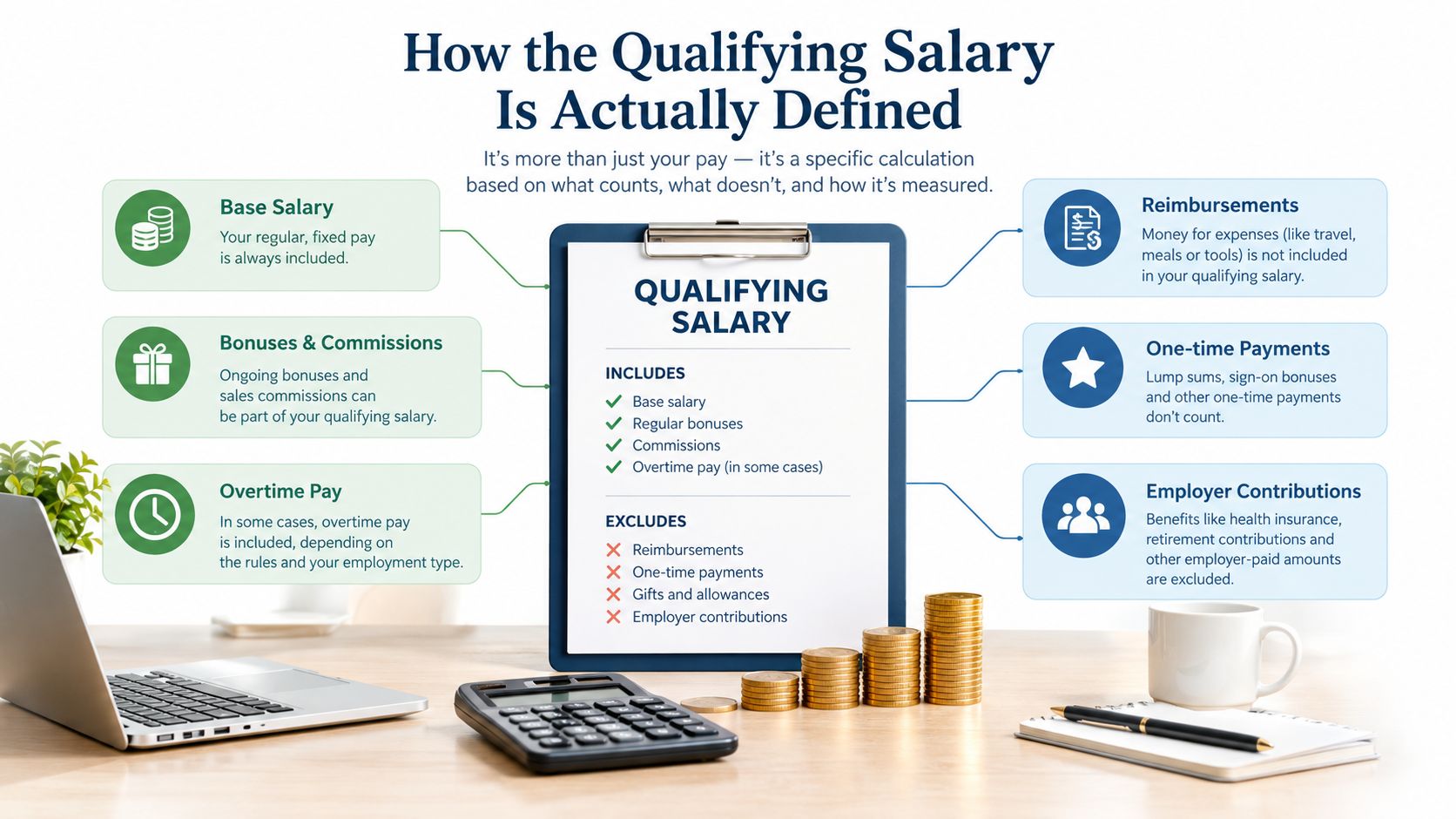
The EP test starts with fixed monthly salary. Under MOM’s Employment Pass eligibility rules, this means the basic monthly salary plus fixed monthly allowances. Qualifying fixed housing, food or transport allowances can count if they are paid in a fixed monthly amount. Variable bonuses, variable allowances, overtime, reimbursements and benefits-in-kind do not count toward the EP salary test (MOM Employment Pass eligibility).
Sector classification changes the threshold. For current new applications, the minimum is S$5,600 for most sectors and S$6,200 for financial services, according to MOM’s eligibility guidance and the EDB summary of the 2025 uplift (EDB summary of the 2025 EP threshold uplift). The financial-services rate follows the employing entity’s sector status, not the candidate’s job title.
Two offers, one role, very different outcomes
A regional finance manager hired by a bank and another hired by a manufacturing group can have the same title and scope, yet face different EP salary tests because the employer sits in a different sector. The bank-backed hire is measured against the financial-services threshold, while the manufacturing hire is assessed against the general-sector threshold.
The clean assessment is straightforward. Start with the guaranteed monthly pay components that qualify as fixed monthly salary, check the sector threshold, then test the package against the candidate’s age and COMPASS. Anything less is guesswork.
Short example of what counts
If a candidate earns S$4,900 basic salary, plus a fixed transport allowance of S$300 and a fixed housing allowance of S$500 every month, the fixed monthly salary for EP assessment is S$5,700. That package clears the current general-sector entry threshold of S$5,600 for a younger candidate, assuming the other EP and COMPASS requirements are also met.
Reading the Age-Progressive Salary Grid
The common mistake is treating the EP qualifying salary as a single flat number. MOM ties it to age, so the bar rises as the applicant gets older because the market expects more senior pay. In practice, a candidate in their mid-40s can face a current general-sector requirement of S$10,700 a month, while the financial-services requirement can reach S$11,800.
The same role can clear at 30 and fail at 45
That is why one job offer can work for a younger candidate and fail for an older one. Two people can hold the same title, report to the same manager, and do the same work, yet the older candidate still needs a higher fixed monthly salary to pass the EP test. Employers should budget for the person, not just the role.
The clean way to assess it is simple. Check the sector threshold first, then test the candidate’s age band, and then compare the offer with the COMPASS C1 benchmark and the S$22,500 exemption ceiling. Those are separate gates, and each one affects how much you can safely offer.
A salary that works for a younger applicant can fail for a mid-career applicant in the same occupation. Under MOM’s framework, that is normal.
MOM’s current guidance keeps the threshold age-adjusted, and its 2026 factsheet also says that from 1 January 2027 the minimum will rise to S$6,000 and S$6,600, with the age-progressive ceilings moving higher as well. These changes apply to new applications from 1 January 2027 and renewals of passes expiring from 1 January 2028 (MOM 2026 factsheet on foreign workforce policies).
For HR teams, the discipline is straightforward. Map the candidate’s age before you negotiate, not after. A junior specialist may fit the current floor with room to spare, while a senior hire may need a much stronger fixed monthly salary before the application even has a chance.
Qualifying Salary vs COMPASS C1 Salary Benchmark
The EP salary gate and the COMPASS salary benchmark are related, but they are not the same test. The qualifying salary is the absolute entry threshold, benchmarked to the top one-third of local PMET salaries by age. COMPASS C1 then checks whether the candidate’s fixed monthly salary reaches relevant percentile bands of local PMET salaries in the employer’s sector (MOM COMPASS C1 salary benchmarks).
| Test | What It Measures | Reference | Outcome If Failed |
|---|---|---|---|
| EP Entry Threshold | Whether the candidate meets the minimum fixed monthly salary for the sector and age band | MOM Employment Pass eligibility | The candidate is ineligible, even if COMPASS points are strong |
| COMPASS C1 Salary Test | Whether the fixed monthly salary reaches the relevant salary benchmark percentile for local PMET peers | MOM COMPASS C1 salary benchmarks | The application may still pass only if other criteria make up the points, but the salary score is weak |
COMPASS C1 should be read precisely. A salary at the 65th percentile to below the 90th percentile earns 10 points. A salary at the 90th percentile and above earns 20 points. A salary below the 65th percentile earns 0 points for C1. Candidates may still pass COMPASS through other criteria, but only if they first meet the mandatory EP qualifying salary.
Decision point: when a package sits right on the floor, it is usually too tight. Build some headroom or expect the application team to fight for points elsewhere.
How COMPASS Scores the Rest of the Application
COMPASS sits around the salary test and judges the rest of the application. Since 1 September 2023, new EP applications have generally been assessed under COMPASS, and renewals were brought in from 1 September 2024. An application normally needs at least 40 points to pass (EDB work pass overview).
The framework looks beyond pay. It weighs the candidate’s qualifications, the employer’s nationality mix, and the company’s support for Singapore’s local workforce and wider skills ecosystem. Bonus criteria can lift a case, but employers should read the scorecard plainly. Salary is only one part of approval.
Why non-salary factors matter in planning
A strong package does not carry a weak application on its own. If the company’s workforce profile is thin or its local development story is weak, the other COMPASS components have to do more work. HR should budget the salary and plan the case together.
the PathSource COMPASS framework overview
For employers who want the framework view while pricing the offer, the relevant official guidance is MOM’s COMPASS overview. The practical point is simple. Price the offer high enough to clear the threshold, then make sure the rest of the file can earn its points.
The S$22,500 Exemption and Who Qualifies
A small group sits above the usual COMPASS process. Candidates with a fixed monthly salary of at least S$22,500 are exempt from COMPASS, while still needing to meet the applicable EP qualifying salary. That same S$22,500 benchmark has also been used for exemptions tied to the Fair Consideration Framework job-advertising rule.
Treat this as a senior-tier budgeting line, not a shortcut for ordinary hiring. It usually fits top leadership, regional specialists with rare market value, or roles where the pay structure is built around very high fixed monthly salary.
The planning rule is straightforward. If the offer is far below that level, COMPASS still has to be budgeted for. If the package does reach S$22,500, the employer still must clear the standard EP salary test, because the exemption removes COMPASS only.
Current Thresholds, Renewals and Announced 2027 Changes
Separate current rules from announced changes before you budget the offer. For new applications now, the minimum is S$5,600 for most sectors and S$6,200 for financial services. For renewals, the higher requirement applies to passes expiring from 1 January 2026, so salary gaps should be checked well before the renewal window opens.
The 2027 changes are already announced, but they are not today’s test. From 1 January 2027, the minimum will rise to S$6,000 for most sectors and S$6,600 for financial services, with age-progressive ceilings moving to S$11,500 and S$12,700 respectively. Those changes apply to new applications from 1 January 2027 and renewals of passes expiring from 1 January 2028. Treat that as a future budgeting line, not a current filing rule.
For hiring plans straddling 2026 and 2027, work from the submission date and the renewal timing. A new application uses the rule in force on the day it is filed. A renewal uses the timing rule tied to the pass expiry, so a wrong salary assumption can derail the case fast.
For the full application sequence, use this Employment Pass application process guide as a companion reference when checking timing and salary structure.
General Sector vs Financial Services at a Glance
Sector attribution is tied to the employing entity, not the candidate’s title or discipline. An engineer hired by a financial institution is tested under the financial-services threshold, while the same engineer hired by a non-financial employer is tested under the general-sector threshold.
| Sector | Current Minimum | Current Max (Age 45+) | From 1 Jan 2027 Minimum | From 1 Jan 2027 Max |
|---|---|---|---|---|
| General sector | S$5,600 | S$10,700 | S$6,000 | S$11,500 |
| Financial services | S$6,200 | S$11,800 | S$6,600 | S$12,700 |
That distinction matters because employers often budget by job family instead of employing entity. MOM does not. The right comparison is always the sector in which the candidate will be employed, then the age band, then the application date.
A Four-Step Budget Check Before Issuing the Offer
A proper EP budget needs the same four checks every time. First, confirm the employer’s sector classification. Second, apply the candidate’s age to the correct current threshold. Third, pressure-test the package against COMPASS, including the C1 salary benchmark. Fourth, screen for the S$22,500 exemption only if the fixed monthly salary is in that territory.
The order matters because offers are often built in the wrong sequence. Recruiters or hiring managers get excited about the candidate, salary bands get rounded up with the wrong assumptions about what counts as fixed monthly salary, and the application team inherits a package that never had a clean compliance structure. That creates avoidable rework.
Use this as the pre-offer habit:
- Confirm the sector first. General-sector and financial-services thresholds are different, and the employer’s entity decides which one applies.
- Check the age band next. A younger candidate and a mid-40s candidate do not sit on the same minimum.
- Run the COMPASS view early. Salary can clear the EP threshold and still earn 0 points under C1.
- Test for exemption only at the top end. If the package is nowhere near S$22,500, do not plan around COMPASS relief.
The offer letter should then reflect the actual application requirements, not the other way around. That is the cleanest way to avoid rescinding or reworking a package after the candidate has already accepted.
If the compensation story only works after several assumptions are stretched, the budget needs another pass.
Common Planning Mistakes Singapore Employers Make
One team budgets a sales hire at a single flat figure for all ages. The 29-year-old candidate clears the threshold, the 45-year-old candidate does not, and the employer acts surprised. The fix is to use age as part of the initial salary model, not as an afterthought.
Another employer misclassifies pay items. The offer looks healthy on a spreadsheet, but too much of the package sits in variable pay, reimbursements or non-qualifying items. MOM’s salary test follows the fixed monthly figure, so the remedy is to structure enough of the package as qualifying fixed monthly salary.
A third employer times a renewal against the wrong threshold. The pay package matched the current rule, but the file was submitted after a policy change had already taken effect for the relevant renewal. The cure is to match the salary model to the application date and renewal timing, then re-check the figure before filing.
Those are not edge cases. They are routine mistakes in Singapore hiring files, and they are preventable.
Quick Reference and Where to Get Help

Keep this compact check in front of the hiring plan:
- Current EP minimums: S$5,600 for the general sector, S$6,200 for financial services.
- Current age ceiling: up to S$10,700 for the general sector, up to S$11,800 for financial services for candidates in their mid-40s.
- Announced 2027 minimums: S$6,000 for the general sector, S$6,600 for financial services.
- Announced 2027 age ceiling: up to S$11,500 for the general sector, up to S$12,700 for financial services.
- COMPASS pass mark: 40 points.
- COMPASS exemption tier: fixed monthly salary of at least S$22,500.
Use these as four separate budget checks, not one flat number. First, confirm the entry-level minimum. Then test the age-progressive ceiling, the COMPASS C1 benchmark, and the S$22,500 exemption threshold. Employers that model all four before issuing the offer avoid most last-minute rewrites.
If the next hire needs an EP-ready package, review PathSource’s Employment Pass application process guide for employer-side support on salary structuring, application paperwork and hiring workflow in Singapore.