

The first sign the Auto Inclusion Scheme has become real is rarely a letter from IRAS. It is usually a founder or HR lead reviewing headcount, realising the team has crossed the line for compulsory participation, and understanding that year-end payroll data now has to move cleanly from the company’s payroll records into IRAS systems. For a growing Singapore employer, that changes payroll from an internal routine into a statutory process that has to be accurate, timely, and aligned with the annual tax cycle.
That is why AIS should be treated as a payroll milestone, not just a tax form. Once a company is in scope, payroll, HR onboarding, and annual reporting become more closely connected, especially when hiring has been fast, roles are mixed across Singaporeans and pass holders, and the finance team is already leaning on payroll outsourcing or external HR support.
When the Auto Inclusion Scheme Becomes Your Problem
A common version of this problem begins with a small employer. A 4-person startup hires two employees during the year, bringing its employee count for the year to 6. At that point, the company may move into compulsory AIS participation, and its payroll data is no longer just for internal records. It has to be prepared for electronic submission to IRAS, and the annual reporting process can no longer be left to the final days before the deadline.
That moment catches founders because AIS does not feel like a standalone tax chore. It behaves more like a control point in the payroll calendar, sitting between hiring, monthly payroll, bonuses, and the employee tax filing season. If payroll setup is weak, AIS often exposes it quickly.
Practical rule: if headcount has grown, the real question is not whether AIS is relevant, it is whether payroll data is already structured well enough to support it without a last-minute scramble.
For employers building a team in Singapore, the issue is bigger than filing one form. AIS affects how compensation data is captured, who owns the information, and whether new hires, pass holders, directors, and leavers are all sitting in one clean reporting workflow. That is why services like Workforce Launchpad matter for lean teams that need hiring, HR setup, and payroll discipline to grow together instead of as separate fixes.
The practical questions are usually the same. Is the company in scope this year, when does registration happen, and which payroll channel should be used so that year-end reporting does not become a manual cleanup exercise. Those are the questions that decide whether the filing cycle is orderly.
What the Auto Inclusion Scheme Does
The Auto Inclusion Scheme is an electronic reporting pipeline from employer payroll records into IRAS, so employee income details can be auto-included in tax returns instead of being retyped by each employee. IRAS explains the scheme and its scope on its official AIS overview page.
What it changes in practice
IRAS uses employer-submitted data to pre-fill employee tax returns with the employment income details needed for filing. In practice, the employer becomes the source of truth for payroll data, and the employee filing side becomes much simpler once those records are complete and accurate. That is the practical effect of AIS. It reduces manual entry, cuts reconciliation work, and keeps payroll records aligned with tax administration.
The bigger shift is timing. Payroll data has to be ready before tax filing begins, not patched together at the end. For founders and HR leads, that means payroll is no longer just a monthly payment run. It becomes a structured reporting process that sits inside the wider hiring and year-end workflow.
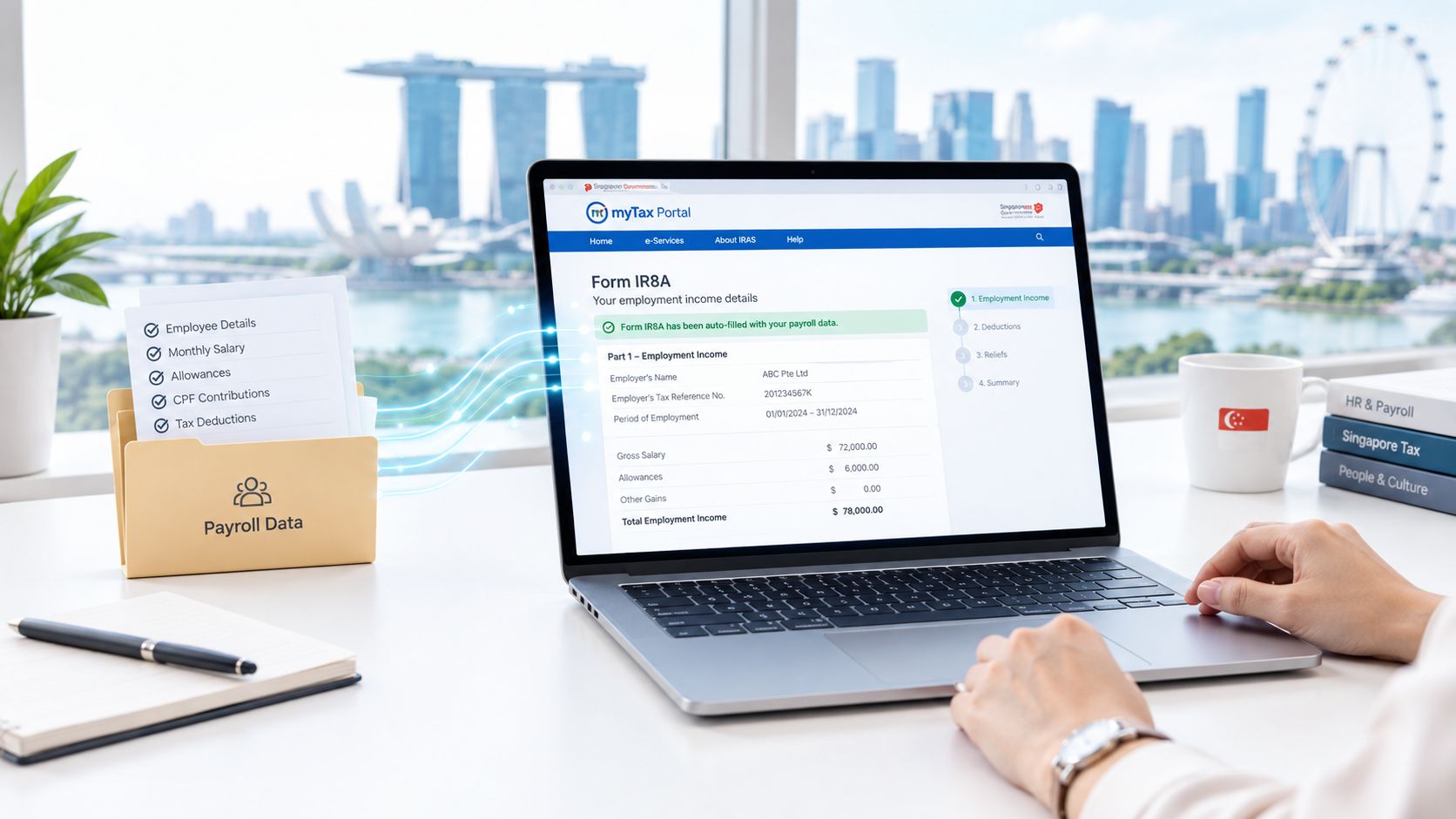
AIS is an annual income reporting channel to IRAS, distinct from the monthly CPF submission cycle. CPF still runs monthly, while AIS sends employer payroll data into the tax process for year-end reporting.
Employers should treat AIS as the reporting spine behind tax filing, not a side task sitting beside payroll.
Once registered, the employer has to submit the payroll data for covered employees by the annual deadline. That makes payroll ledger quality, income classification, and employee record completeness matter far more than many teams expect on first review.
For Singapore SMEs, this also changes how payroll outsourcing works. If a provider is handling payroll, the reporting setup still needs to capture directors, Employment Pass hires, and founder-led headcount growth cleanly, or AIS becomes a year-end reconciliation exercise.
Who Must Register and When
Under current IRAS guidance, employers with 5 or more employees for the relevant basis year must participate in AIS, unless IRAS states otherwise. For Year of Assessment 2027, that means looking at the employee count during calendar year 2026, and the count is not limited to employees who are still on payroll at year end. IRAS states that employers should include employees who left during the year when determining whether participation is compulsory. Employers that are already on AIS generally continue to file electronically. These rules are set out on the official IRAS join AIS page.
How to read the threshold correctly
The count is not just about full-time local staff. IRAS guidance indicates that it can include full-time and part-time resident employees, non-resident employees, certain overseas-based employees rendering services in Singapore, and company directors. This is where smaller companies often get caught out. A founder who thinks only local payroll headcount matters can misjudge scope quickly, especially when the team mixes Singapore hires with foreign hires and founder-directors.
Registration timing matters just as much as eligibility. IRAS states that employers joining AIS should register by 1 March. For the current upcoming cycle, employers reporting employment income for 2026 should generally complete registration and submit the relevant records by 1 March 2027, based on the applicable IRAS guidance for joining AIS and submitting employment income records. IRAS also notes that where an employer registers between 1 January and 1 March, it may choose to register for the current YA or the next YA.
| Employer Scenario | AIS Trigger | Registration Channel |
|---|---|---|
| New employer reaches 5 or more employees in the relevant year | Registration is generally required for the relevant YA | Payroll software with AIS API, myTax Portal, or tax agent |
| Existing AIS employer, even if headcount later drops | Usually remains in the AIS filing process | Uses the existing AIS reporting setup |
| Smaller team reviewing future growth | Should assess whether the 5-employee threshold will be met during the year | myTax Portal, AIS-enabled payroll software, or agent support |
For employers hiring pass holders, a tighter Employment Pass HR setup in Singapore pays off. If HR and payroll are connected properly from day one, the new hire’s details are already in the system before year-end.
Useful rule: if the company is close to the threshold, do not wait until the filing season to work out whether AIS applies. Registration planning belongs in the same conversation as hiring and payroll setup.
The AIS Reporting Workflow Step by Step
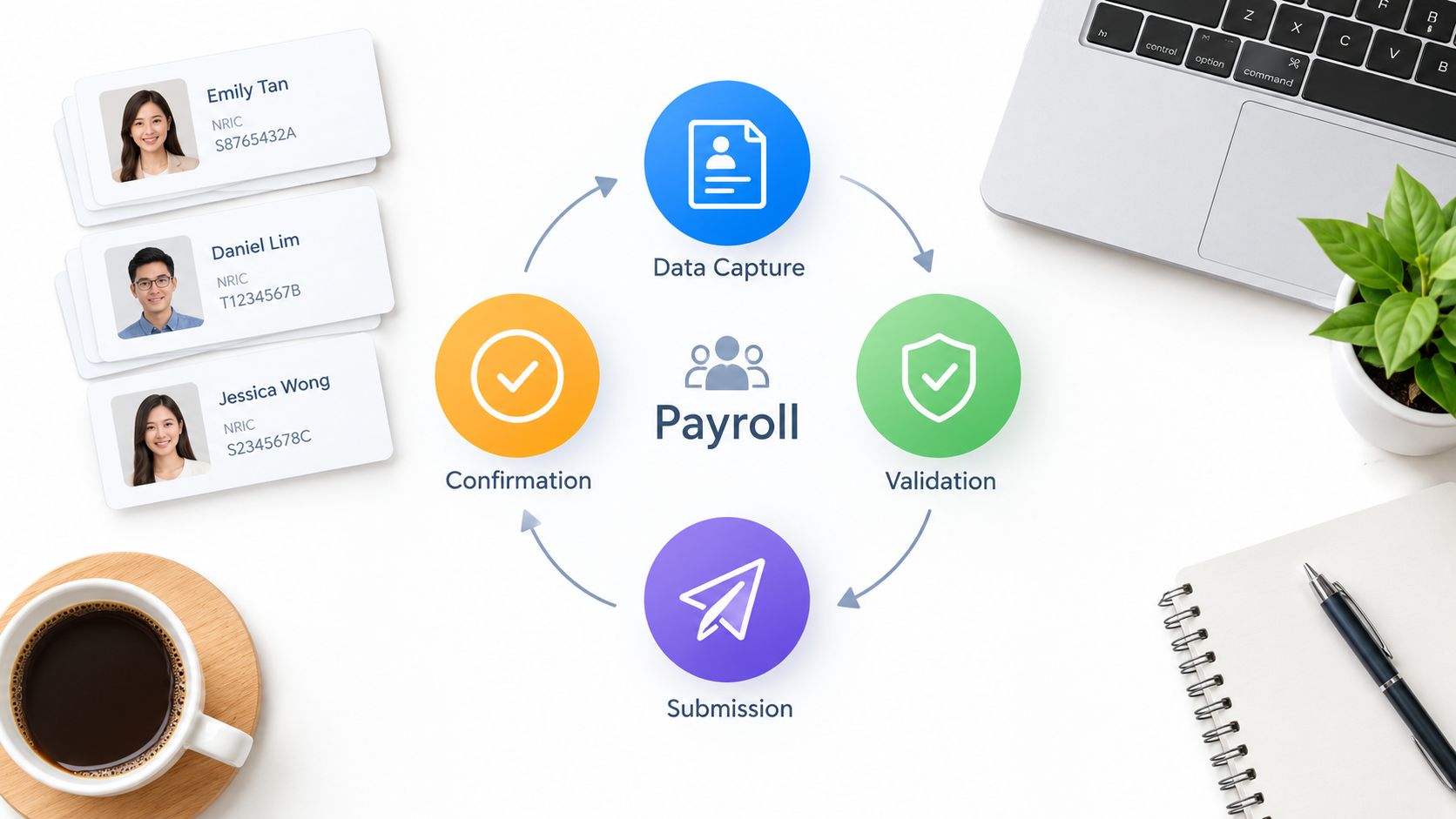
AIS is best handled as a repeatable payroll cycle, not as a once-a-year data dump. The employer’s job is to make sure the right fields are captured, classified, checked, and transmitted in a form IRAS can use without unnecessary correction.
Start with clean employee data
The reporting file needs employee identity details and employment income information to be complete. That includes name, NRIC or FIN, address, gross salary, bonuses, director fees, and other reportable employment income details reflected in the payroll ledger. If any of those fields are inconsistent with HR records or payroll histories, the submission becomes riskier.
The data also has to reconcile with the company’s own payroll system. That is the critical control point. If payroll says one thing and the submission file says another, someone in finance or HR may have to explain the gap.
Choose the submission path that matches the team
IRAS currently supports AIS submission through payroll software integrated with the AIS API and through the Submit Employment Income Records digital service in myTax Portal. IRAS strongly encourages employers using payroll software to use software integrated with the AIS API. Employers that do not use payroll software, need to amend records, or use the CPF Data Link-up Service may submit through myTax Portal instead.
Payroll should be designed so that year-end reporting follows from good monthly records, not from a separate reconstruction exercise.
The reporting file is broader than base salary. Depending on the employee and payment type, it may need the right treatment for bonuses, director fees, approved deductions, and other employment income items reportable under IRAS guidance. Employers should rely on the official IRAS reporting employee earnings guidance when mapping specific payroll items.
At the same time, employers should not assume every benefit sits inside AIS in the same way. Some items may require separate analysis or separate reporting treatment, which is why payroll owners should review compensation design rather than relying on assumptions.
For non-residents who leave Singapore mid-cycle, the Form IR21 tie-in matters as well. That means AIS should sit inside a broader offboarding and payroll control process, not in isolation.
Deadlines, Penalties and What IRAS Does With the Data
The core deadline remains 1 March. Under current IRAS guidance, AIS employers must submit the previous year’s employment income data by 1 March each year. For income earned in 2026, the relevant deadline is 1 March 2027. IRAS confirms this on its submission page.
IRAS states that late submission may lead to a fine of up to $5,000. IRAS also indicates that inaccurate information may attract separate penalties under the Income Tax Act, so employers should avoid treating the deadline as the only compliance issue. Where needed, employers should refer directly to IRAS or obtain tax advice on the consequences of specific errors.
What happens after submission
IRAS uses the employer file to pre-fill employee tax returns and support the filing process through myTax Portal. That is why accuracy matters so much. A clean file reduces employee queries and keeps the annual filing cycle moving, while a poor-quality file can create follow-up work across multiple employee records.
| Trigger | Deadline | Penalty / Consequence |
|---|---|---|
| Annual employer submission of employment income data | 1 March | Late submission may lead to a fine of up to $5,000 |
| Incorrect or incomplete payroll data | At submission time | Amendments, reconciliation, or possible penalties may be required |
| Data passed into employee tax filing | From the filing season onward | Pre-filled returns may need review if records are wrong |
The operational risk is often bigger than the fine. If one payroll row is wrong, the issue can carry into multiple employee tax records and require reconciliation with IRAS. That becomes a problem for HR, payroll, and finance at the same time, which is why AIS should be treated as a controlled process.
AIS penalties sit inside the income tax framework, so they should not be confused with CPF, GST, or other employer obligations. Each regime has its own rules, and payroll teams need to keep them separate in practice even when the same people handle the paperwork.
Common Pitfalls Singapore Employers Hit With AIS
One common mistake is assuming AIS employers must still issue hardcopy Form IR8A to employees after electronic submission. Under current IRAS guidance, that is generally not required for employers on AIS. Once employment income information has been submitted electronically under AIS, the employer usually does not need to give employees hardcopy Form IR8A or the relevant appendices. Employees’ income details will generally be auto-included in their tax returns, and employers may provide a separate statement of earnings for record purposes if needed. Employers that are not on AIS still need to provide Form IR8A and any required appendices by 1 March. Employers should check the official IRAS reporting employee earnings guidance for the current position.
Where employers usually get it wrong
Benefits-in-kind are another weak spot. Company cars, housing benefits, and stock option arrangements often sit outside the normal monthly payroll rhythm, so they can be missed when year-end reporting is assembled in a rush. Once that happens, the employer has a compensation record problem, not just a filing problem.
New hires on Employment Pass can create a separate gap when they join late in the year and the payroll system does not have the FIN details ready in time. That is usually an HR onboarding issue, not a tax issue. If the employee master data is incomplete, AIS reporting becomes slower and more fragile.
Some employers also over-report or misclassify director fees and non-resident contractor payments because they assume all payments should be treated the same way. They should not. Director remuneration, contractor payments, and employee income are different categories, and payroll teams need to keep those lines clear.
The cleanest AIS submission is the one built from properly coded payroll items, not one rebuilt from email threads near the filing deadline.
The final misconception is that monthly CPF payment somehow settles AIS. It does not. CPF and AIS are separate obligations, and good payroll operations have to satisfy both without mixing their logic.
Connecting AIS to Payroll, EP and HR Setup
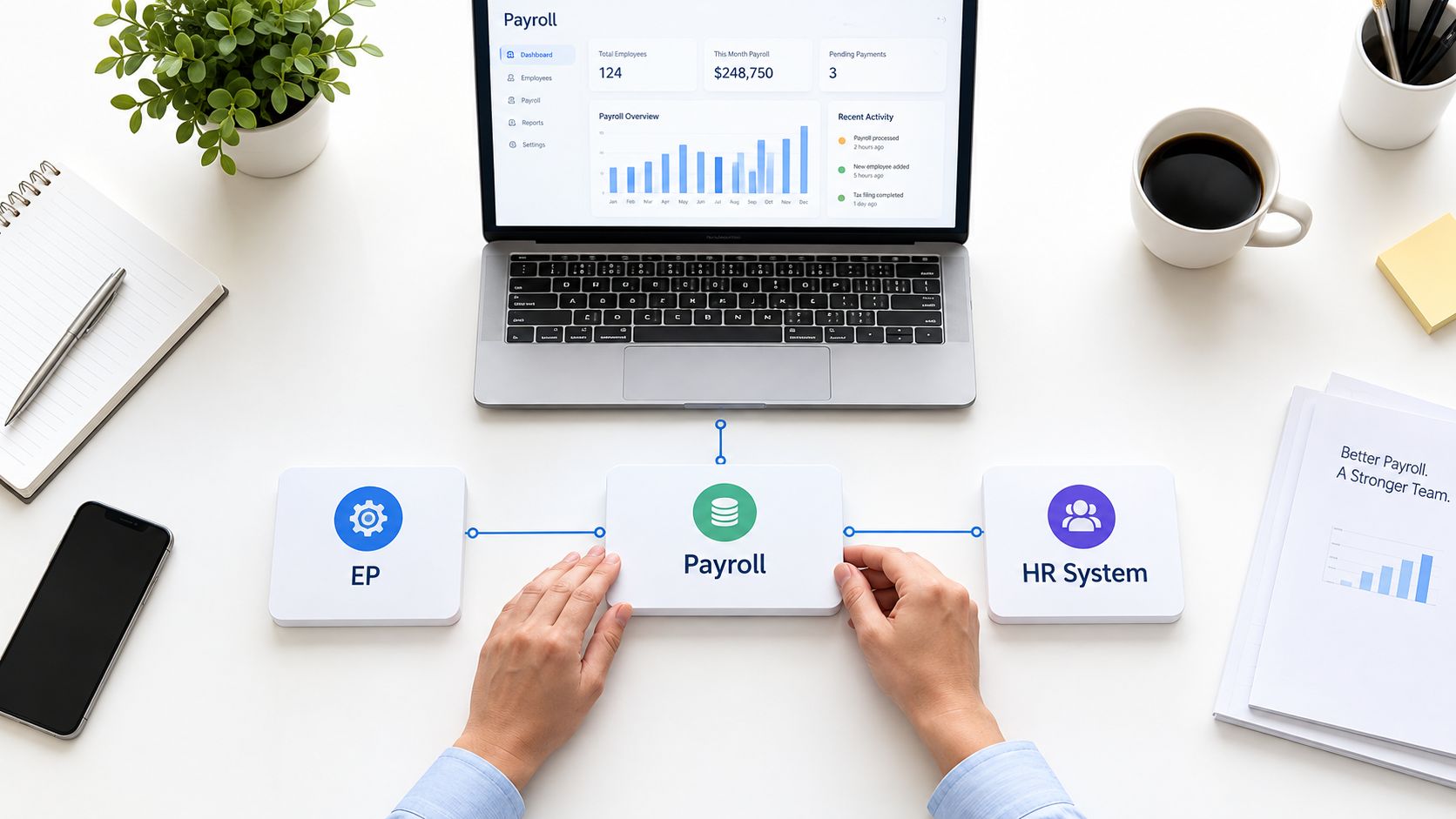
AIS only works well when the payroll setup is already disciplined. If variable pay, allowances, new-hire data, and leaver records live in different spreadsheets, the submission will usually be messier. If they sit inside one payroll structure, the reporting path becomes much easier to control.
What should be aligned this quarter
Employers should first decide whether payroll submissions will run through software with AIS API access or through the myTax Portal process. That decision shapes how payroll is maintained, how approvals are handled, and how much manual checking is needed near the deadline.
They should also align AIS readiness with Employment Pass onboarding. If pass-holder details are captured late, payroll gaps appear later, and year-end reporting becomes harder than it needs to be. HR setup has to cover the full employee lifecycle, not only the offer letter.
A simple control list helps:
- Clean employee master data: Make sure names, identity numbers, addresses, and employment start dates are captured correctly from onboarding.
- Code pay items properly: Separate salary, bonuses, director fees, allowances, and benefits so they can flow into reporting without unnecessary rework.
- Keep payroll and HR talking: If a hire, transfer, or exit happens, the payroll file should reflect it before the next pay run.
- Review reporting ownership: Someone needs to own AIS checks, not just payroll disbursement.
For employers that prefer outside support, PathSource Consulting can support payroll outsourcing, statutory payroll handling, Employment Pass coordination, and HR setup for growing teams. That is most useful where hiring is active and internal HR capacity is still being built.
Wrapping Up and Getting AIS Right
AIS is not just a tax-season administrative task. It is a payroll milestone that shows whether a Singapore employer has built sound controls around hiring, compensation, and year-end reporting. When managed well, employees receive cleaner pre-filled returns, IRAS reconciliation becomes simpler, and the HR team avoids unnecessary disruption during filing season.
The priorities are straightforward. Confirm whether headcount triggers registration, choose a submission channel before the 1 March 2027 deadline for reporting 2026 income, capture all reportable income correctly, and reconcile AIS records against payroll and related employment tax obligations. For founders and HR leads, the real benefit is not just compliance. It is having a payroll process that can handle growth without creating avoidable filing risk at year end.
If AIS is now part of a wider hiring or payroll setup problem, PathSource Consulting can support the structure behind it, from payroll outsourcing to Employment Pass onboarding and HR setup. Visit PathSource Consulting to discuss the team’s hiring requirements and payroll support needs.