

A Singapore founder has three vacancies open at once: a mid-level finance analyst, a regional product manager and a specialist AI engineer. The HR function is lean, hiring managers are already carrying quarterly targets, and every interview delay pushes delivery risk further into the business.
That situation is common among growth-stage employers. Recruitment process outsourcing in Singapore can provide useful capacity, but it isn't a universal replacement for internal judgement or specialist search. The right question isn't whether to outsource recruitment. It's which part of hiring should be outsourced, for which roles, and with what level of founder or hiring-manager involvement.
Why Singapore Employers Are Rethinking How They Hire
A finance analyst, regional product manager and AI engineer can sit in the same hiring plan while demanding completely different search methods. The analyst may need a disciplined process and a clear shortlist. The product manager may require regional market judgement, stakeholder assessment and discreet outreach. The AI engineer may need a specialist search led by someone who can test the brief and assess technical depth. Treating these roles alike wastes time and weakens hiring decisions.
Ministry of Manpower Labour Market Report for 1Q 2026
Singapore's labour market remains relatively tight. The Ministry of Manpower Labour Market Report for 2Q 2026 records 68,600 job vacancies in June 2026, equal to 1.48 vacancies for every unemployed person, while noting that vacancies eased during the quarter even as demand for talent remained above the number of unemployed people available.
For a small team, an open role quickly becomes an operating problem. A founder may have to cover commercial work, a manager may delay a product milestone, and an existing employee may inherit responsibilities outside the original role. A poor appointment adds another cost. The team absorbs the disruption while restarting the search.
Cross-border hiring adds operational work. An Employment Pass candidate must meet current salary and assessment requirements, and some roles may also require Fair Consideration Framework advertising unless an applicable MOM exemption applies. An operational hire may require Work Permit checks and employer documentation. Recruitment therefore connects workforce planning, immigration readiness, role design and start-date management with candidate sourcing.
Practical rule: Outsource repeatable process that is slowing the business. Keep judgement with the founder or hiring manager when the role is confidential, business-critical or difficult to assess.
RPO is a spectrum, not a single package. A Singapore SME may need a project team for a hiring burst, an embedded recruiter for a defined period, or structured sourcing and coordination for repeatable roles. One difficult appointment may still belong with a specialist search adviser or the founder.
Choose the engagement around the hiring situation. Use RPO for capacity and consistency. Keep specialist assessment and final conviction close to the people who understand the business.
What Recruitment Process Outsourcing Actually Covers
Recruitment process outsourcing, or RPO, is the transfer of all or part of a hiring workflow to an external provider that takes responsibility for an agreed process. The provider may support workforce planning, role scoping, sourcing, screening, interview coordination, offer management, onboarding support and reporting. The employer still owns the final hiring decision unless the contract states otherwise.
The practical distinction is accountability. A contingency agency usually presents candidates for individual vacancies. An RPO partner works within an agreed operating model, with defined responsibilities, communication routines and reporting. That makes the model useful when the employer needs a repeatable hiring function rather than occasional candidate introductions.
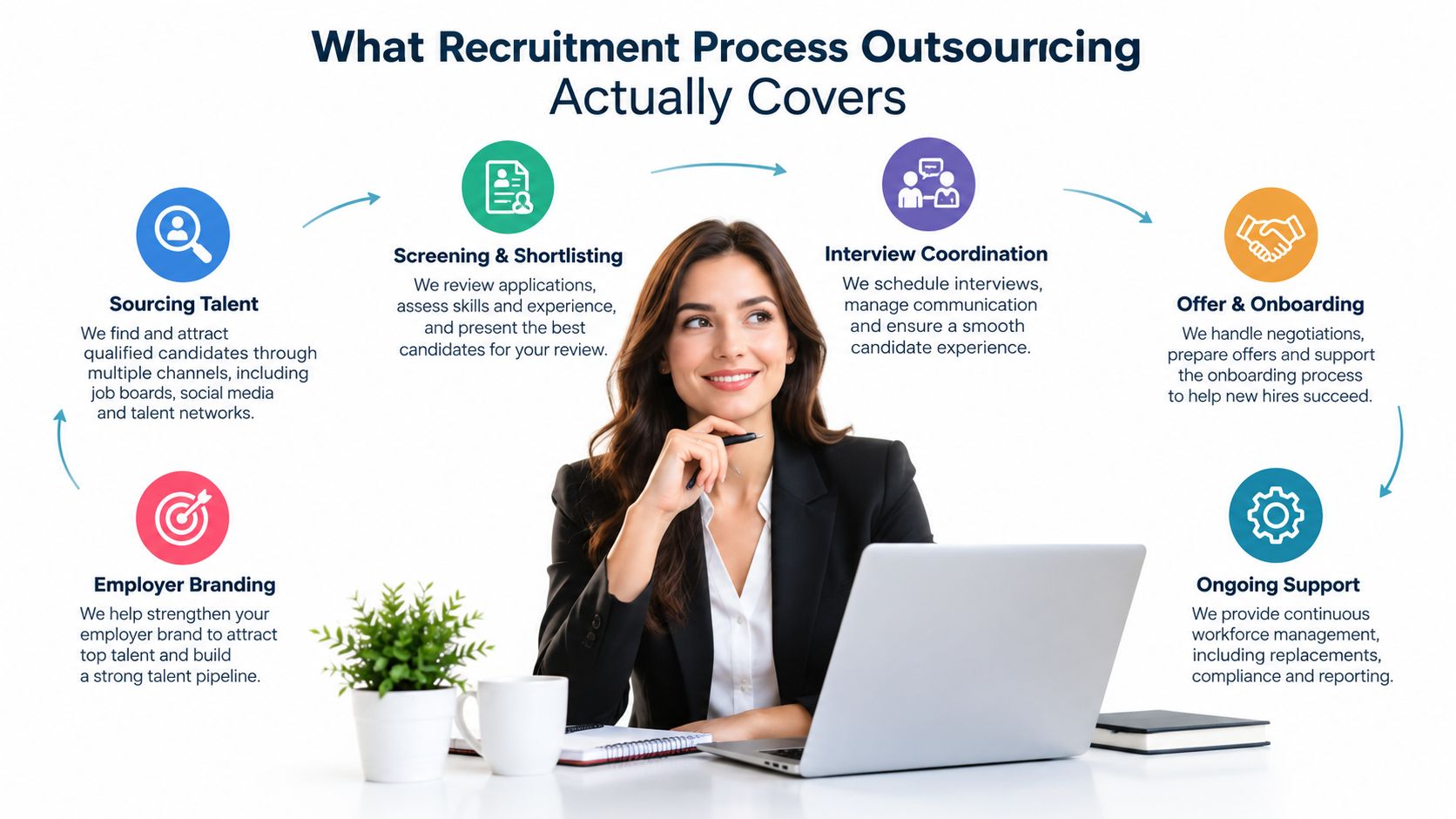
Four engagement models employers can use
End-to-end RPO transfers most of the recruitment workflow, from requisition intake through onboarding support and reporting. It suits employers with sustained hiring across departments, locations or role families, particularly when the internal HR team needs a consistent process rather than occasional extra hands.
Project RPO is built around a defined hiring requirement. A company launching a new function, opening a Singapore office or clearing a backlog of specialist roles may use this model without committing to a permanent outsourced structure. The scope should specify roles, decision-makers, timelines, sourcing ownership and the point at which the project ends.
Embedded Recruitment as a Service, or RaaS, places a recruiter or recruitment team inside the employer's working rhythm. The recruiter joins hiring meetings, uses the agreed systems and represents the employer to candidates. This is often the strongest option for an SME that needs ongoing recruitment capability but doesn't yet need a full internal talent acquisition team.
On-demand recruiter support covers ad-hoc needs such as sourcing for a confidential search, screening an urgent shortlist or supporting a hiring manager through a temporary capability gap. It provides flexibility, but the employer must define what the recruiter owns. Without a clear handover, on-demand support can become a sequence of disconnected tasks.
The right model depends on the hiring pattern:
- A sudden burst points towards project RPO.
- A steady stream of roles supports embedded RaaS or end-to-end RPO.
- One confidential specialist appointment may justify founder-led executive search.
- A short administrative gap may only require on-demand support.
RPO works best when the provider receives enough context to understand the business, not just a job description. The briefing should cover success measures, reporting lines, team dynamics, location, work authorisation considerations and the reasons a strong candidate would accept the role.
RPO Compared With In-House, Contingency and Embedded RaaS
No hiring model wins on every criterion. Employers should compare options against the same practical questions: How predictable is the cost? Who controls the daily process? Can the model handle specialist or confidential roles? What happens when hiring volume changes?
| Criteria | In-House | Contingency Agency | Embedded RaaS | RPO |
|---|---|---|---|---|
| Cost predictability | Strong once the team is established, with fixed employment costs | Lower fixed commitment, but spend varies by successful hire | Usually more predictable through an agreed service arrangement | Predictable when scope, volume and responsibilities are clearly defined |
| Day-to-day control | Highest | Employer controls decisions, agency controls its own sourcing | Shared control, with the recruiter working closely with the team | Shared control through agreed governance and service levels |
| Typical use | Steady-state hiring with an established talent acquisition function | One-off or occasional vacancies | Ongoing support without building a full internal team | Sustained, multi-role hiring requiring process discipline |
| Specialist or confidential roles | Strong when internal expertise exists | Useful if the agency has the relevant network | Strong when the embedded recruiter understands the sector | Strong if the provider has genuine specialist capability |
| Scalability | Expansion requires hiring or reallocating internal staff | Easy to add agencies, but coordination can become difficult | Scales with the agreed recruiter capacity | Designed to scale across defined hiring programmes |
| Reporting and process ownership | Depends on internal maturity | Usually focused on vacancy activity | Stronger than contingency when reporting is agreed | Central to the engagement |
| Confidentiality | Direct internal control | Requires careful disclosure and agency selection | Managed through integration and access controls | Managed through contract, governance and restricted information access |
When in-house hiring is the better answer
In-house recruitment is usually the strongest fit for a larger employer with steady hiring, experienced hiring managers and an established talent acquisition function. Internal recruiters build institutional knowledge over time and can influence workforce planning, mobility and employer branding beyond individual vacancies.
It becomes less attractive when one HR generalist is supporting payroll, employee relations, onboarding and multiple specialist searches at the same time. In that situation, the issue isn't that internal hiring is wrong. The issue is that the business hasn't provided enough capacity for it to work well.
Where contingency agencies fit
Contingency recruitment can be appropriate for an individual mid-level role when the employer has time to brief several agencies, compare shortlists and manage duplicate submissions. It can also work when the vacancy is clearly defined and the market is broad.
The trade-off is coordination. Multiple agencies may approach the same candidates, interpret the brief differently and create uneven candidate experiences. Employers considering a more structured alternative should understand the difference between retained and contingency recruitment, especially for searches where market mapping and confidentiality matter.
Why embedded RaaS sits between the models
Embedded RaaS gives an employer recruiter capacity without requiring permanent internal headcount. It usually provides more ownership and context than a contingency arrangement, while remaining narrower and more flexible than full RPO.
True RPO is the strongest fit when several roles need a consistent process, reporting matters and the employer wants an external partner to own defined parts of recruitment. The decision should follow the hiring pattern, role seniority and internal HR maturity, not the model a provider happens to sell.
Benefits and Trade-Offs for Singapore Employers
A lean Singapore HR team can lose weeks coordinating specialist hiring while managers refine briefs, review unsuitable profiles and chase interview feedback. RPO adds capacity, but it should be matched to the hiring problem rather than treated as a standard outsourcing package. It can support several roles with a shared process, while specialist search, founder involvement or in-house hiring may be better for a single sensitive appointment.
Singapore's tight talent market increases the value of targeted external support. ManpowerGroup reported in January 2025 that 83% of employers in Singapore struggled to find the skilled talent they needed in 2025. That finding is useful market context, but it should be read as a private employer survey rather than an official Singapore labour-market statistic.
Where RPO creates practical value
- Capacity: A project team can manage sourcing, screening and interview coordination while internal leaders focus on decisions.
- Scalability: Employers can increase support during expansion and reduce it when the hiring programme closes.
- Market reach: Specialist recruiters may know where relevant candidates work, what motivates them and which messages secure a response. See our guide to specialist recruitment agencies for how sector-focused sourcing differs from general advertising.
- Process consistency: A defined workflow can reduce gaps in briefing, feedback collection, candidate updates and offer coordination.
- Employer representation: A properly briefed external team can apply consistent messaging across channels and hiring managers.
The operational gain is clearest when several roles share a hiring pattern. The provider can standardise intake, track candidate movement and identify delays, while the employer retains decisions on selection, compensation and team fit.
RPO does not remove management responsibility. If leaders delay feedback or change requirements repeatedly, an external team will only expose those bottlenecks more clearly.
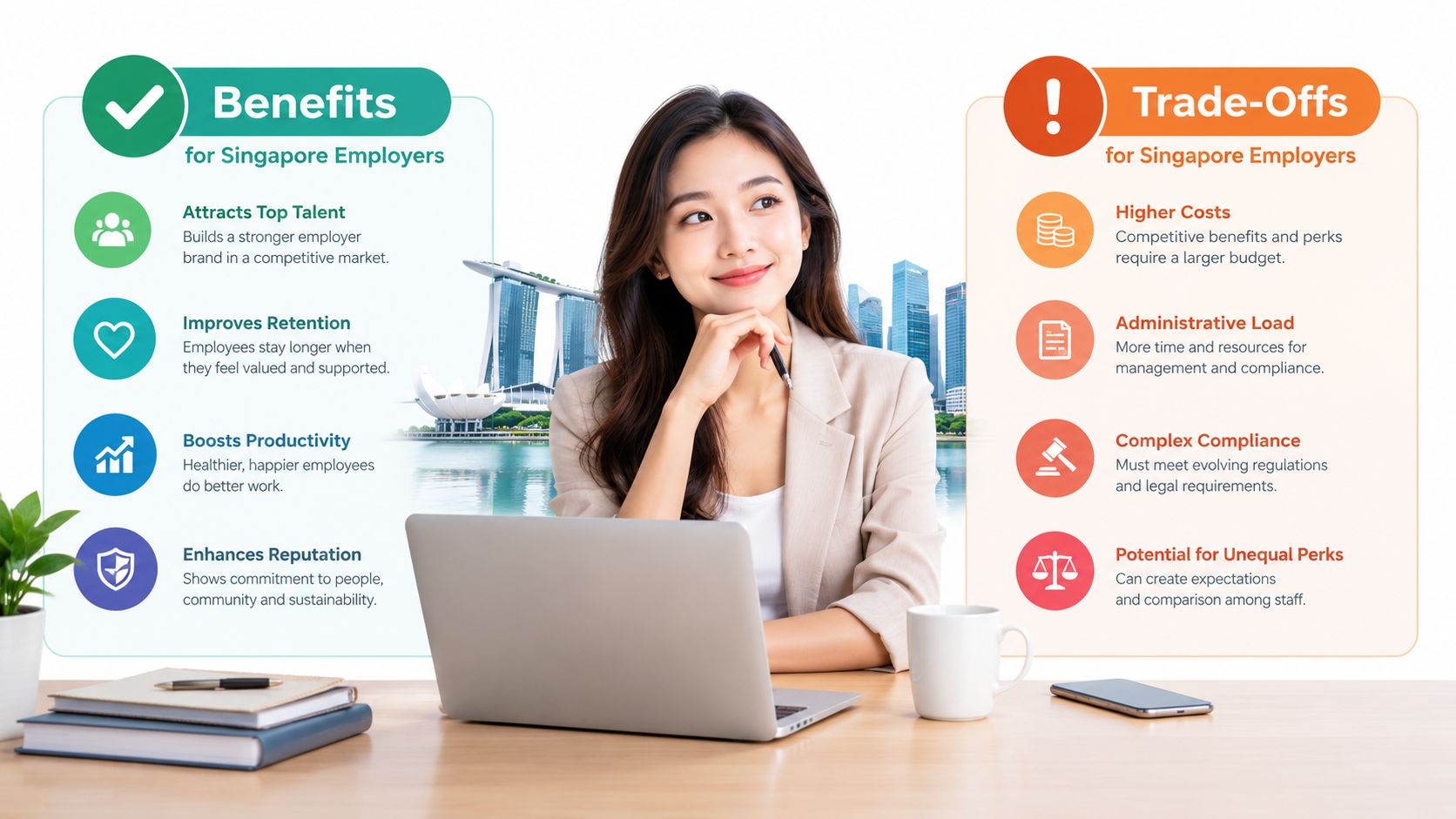
The trade-offs deserve equal attention
Provider dependence creates a knowledge risk. If the external team owns every candidate conversation and hiring manager relationship, the employer may lose recruitment knowledge when the engagement ends. Require a handover plan covering active pipelines, rejected candidates, market intelligence, role documentation and access to agreed records.
Culture-fit risk also needs attention. Screeners unfamiliar with the sector may overvalue keyword matches and miss the behaviours that matter in a small team. Specialist or senior roles need direct calibration with the hiring manager, not just high-volume processing.
Confidential appointments may require founder involvement. The provider can handle discreet market mapping and initial contact, while the founder controls the relationship and final assessment. For a single sensitive search, specialist recruitment may outperform a broad RPO programme.
Employers should also specify how candidate data is handled, where systems are hosted and who can access records. Put those duties in the contract and operating plan, with responsibilities aligned to the employer's data protection obligations.
Singapore-Specific Rules That Shape Any RPO Engagement
An RPO partner in Singapore must manage more than candidate flow. The engagement should assign ownership for eligibility checks, documents, work-pass applications, payroll inputs and start-date planning before sourcing begins. If those responsibilities remain vague, a fast hiring process can still produce a delayed or non-compliant start.
Employment Pass planning starts with the role
The role, salary and candidate profile must be assessed together. MOM's Employment Pass eligibility requirements state that candidates must earn at least S$5,600 per month in most sectors and S$6,200 in financial services. Under the current rules, thresholds rise progressively with age, reaching S$10,700 and S$11,800 for candidates aged 45 and above. Higher thresholds have been announced and are scheduled to apply to applications from 1 January 2027 and renewals expiring from 1 January 2028. Employers should confirm the thresholds in force when each application is submitted.
Most online Employment Pass applications are processed or updated within 10 business days. For overseas companies without a Singapore-registered entity, the process can take up to 6 weeks, according to MOM's application guidance. An RPO team should therefore separate locally incorporated employers from overseas entities when setting sourcing targets and proposed start dates. Do not promise a joining date before the work-authorisation path is clear.
Work Permit hiring has a different operating rhythm. Applications are typically processed within 1 week, and the physical card is generally delivered within 5 working days after fingerprint or photograph registration, or document verification where applicable, as stated in MOM's Work Permit process. High-volume operational hiring depends on disciplined document collection and eligibility screening before an offer is finalised.
Licensing and payroll need clear ownership
An organisation may need an employment agency licence if it places jobseekers with employers, communicates with jobseekers about applications, collates resumes to help establish an employment relationship, or submits work-pass applications for employers or jobseekers. MOM licensing guidance also identifies exceptions, including recruitment solely for the organisation's own company and outsourcing its own staff to customer premises. An RPO buyer should confirm which activities the provider will perform, then verify whether the provider's licence covers that scope.
MOM currently distinguishes Comprehensive Licence (All), Comprehensive Licence (Local), Comprehensive Licence (non-FDW), and Select Licence. Comprehensive Licence (All) permits placement of all worker types. Select Licence applies to workers earning more than S$4,500 per month. The licence question should be settled during vendor selection, not after candidate introductions begin.
Payroll handover also belongs in the operating design. The CPF Ordinary Wage ceiling guidance states that the ceiling increased to S$8,000 from 1 January 2026, while the annual salary ceiling remains S$102,000. Employers using RPO with payroll support should specify who validates employee data, prepares documents, coordinates applications and confirms statutory-processing information. A payroll outsourcing arrangement should match those duties to the recruitment handover, with one accountable owner for missing or inconsistent records.
How RPO Pricing Models Actually Work
RPO pricing should follow the hiring pattern, not the other way around. A per-hire arrangement may suit an employer with occasional vacancies, while a retainer can make more sense when the provider is expected to reserve capacity, attend hiring meetings and maintain an active pipeline.
Common structures
Per-hire or success fees link payment to a successful appointment. The model is straightforward for one-off searches, but employers should check whether sourcing, assessment, advertising, reference checks and replacement provisions are included.
Monthly retainers suit full-cycle RPO or embedded RaaS. The employer pays for committed recruitment capacity rather than only completed hires. This can provide stronger continuity for a hiring programme, although unused capacity and termination terms need careful review.
Subscription or talent-pool arrangements provide ongoing sourcing support for companies with intermittent requirements. A startup hiring only a small number of roles each quarter may prefer a defined monthly service, provided the agreement explains how candidates, search time and unused activity are treated.
Hybrid pricing combines a reduced retainer with a success fee. It can balance access to dedicated capacity and payment for results, but the proposal must separate both components so the total cost is visible.
Role scarcity, seniority, exclusivity and assessment complexity influence the commercial structure. Volume hiring may reduce the fee per appointment, while a confidential specialist search requires more market mapping and senior involvement. Employers should negotiate the practical details, including replacement guarantees, rebate windows, advertising spend, contract length, exclusivity, candidate ownership and exit support.
Commercial test: A proposal is only transparent when it shows the cost of internal management time, hiring delays, duplicated agency work and handover activity alongside the stated fee.
A Practical Roadmap to Implementing RPO in Singapore
A controlled rollout is safer than transferring the entire hiring function on the first day. The employer should begin by documenting the problem that needs solving.
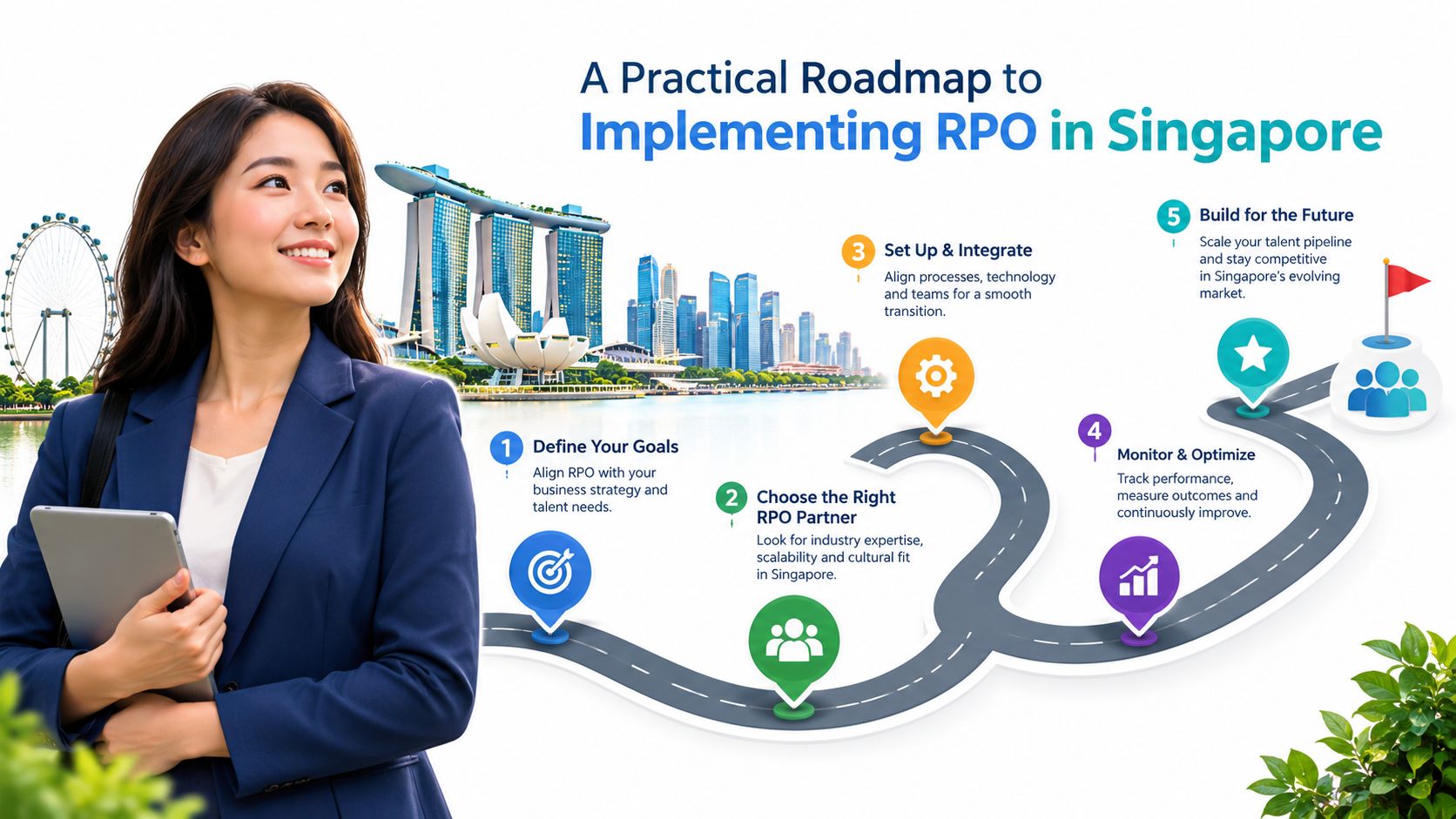
Five decisions before appointing a provider
Define the hiring scope. Record expected role types, locations, seniority, hiring managers, confidentiality requirements and any Employment Pass or Work Permit sensitivity. This determines whether the employer needs project RPO, embedded RaaS, on-demand support or specialist search.
Check provider suitability. Confirm EA licensing where the provider's activities require it, then test sector knowledge through detailed questions. The provider should explain how it would source a difficult candidate, assess the role and challenge an unrealistic brief.
Assign ownership. The contract should state who owns role approval, candidate communication, interview scheduling, offer negotiation, work pass coordination, data access and onboarding handover. Ambiguity here causes delays later.
Set service levels. Agree reporting cadence, response expectations, pipeline definitions, interview feedback windows, replacement terms and escalation routes. Time-to-fill should be discussed, but it shouldn't stand alone. Pipeline quality and hiring-manager responsiveness matter too.
Pilot before scaling. A limited pilot on one or two hires can reveal whether the provider understands the organisation. The employer should review progress at 30, 60 and 90 days, focusing on candidate quality, candidate experience, cost per hire, decision speed and process gaps.
Questions that expose weak proposals
- Who personally owns the search for the most specialist role?
- How does the provider distinguish a qualified candidate from a keyword match?
- What happens to candidate data and active pipelines if the agreement ends?
- Which party prepares and submits work pass applications?
- What information must the employer provide before sourcing begins?
- How are confidential searches separated from general vacancy activity?
- Which costs sit outside the agreed fee?
- What does the employer receive in the final handover?
A vetted provider checklist should cover data security, system access, contract clarity, exit terms, EA licensing status where relevant and MOM compliance responsibility. The employer should also test the proposed communication rhythm with the hiring managers who will use it.
Common Questions From Founders and HR Leaders
When is RPO the wrong choice?
RPO is usually the wrong fit for very low hiring volume, a single niche search that needs senior judgement or a founder-led appointment where confidentiality is paramount. It may also be unsuitable for a startup with an uncertain runway if the engagement creates a fixed commitment without enough recruitment activity. Specialist search or a targeted contingency arrangement may be more proportionate.
How should an SME approach its first engagement?
An SME should start with a defined hiring problem, not a broad instruction to outsource recruitment. A project covering a small group of related roles gives the provider enough context to build a process while allowing the employer to test communication, candidate quality and decision ownership.
The employer should keep final assessment and hiring approval internally. The provider can own sourcing, screening, coordination and reporting, but the founder or functional leader should remain close to roles that will materially affect the business.
What should a pilot prove?
A pilot should demonstrate whether the provider can understand the brief, reach relevant candidates, communicate clearly and keep the process moving. The contract should define reporting, replacement terms and responsibilities before the first search begins. No provider can remove the employer's obligation to make timely decisions or present a credible role.
Where does the EA licence boundary sit?
The boundary depends on the activities performed. Employers should ask the provider to identify which services require licensing and confirm the arrangement against MOM's stated EA requirements. Work pass support, candidate communication and placement activity should never be left to assumption.
A 40-person technology firm, for example, might use project RPO to address a backlog of specialist roles within one quarter, then return routine hiring to its internal team while retaining external support for difficult searches. The decision rule is simple: outsource repeatable process and capacity, retain business-critical judgement, and choose specialist search when one appointment carries disproportionate risk.
PathSource Consulting supports Singapore employers through founder-led executive and specialist recruitment, embedded recruitment capacity, Employment Pass and work pass support, payroll outsourcing and HR setup. Employers planning an RPO, project hiring programme or difficult specialist search can discuss their requirements with PathSource Consulting.