
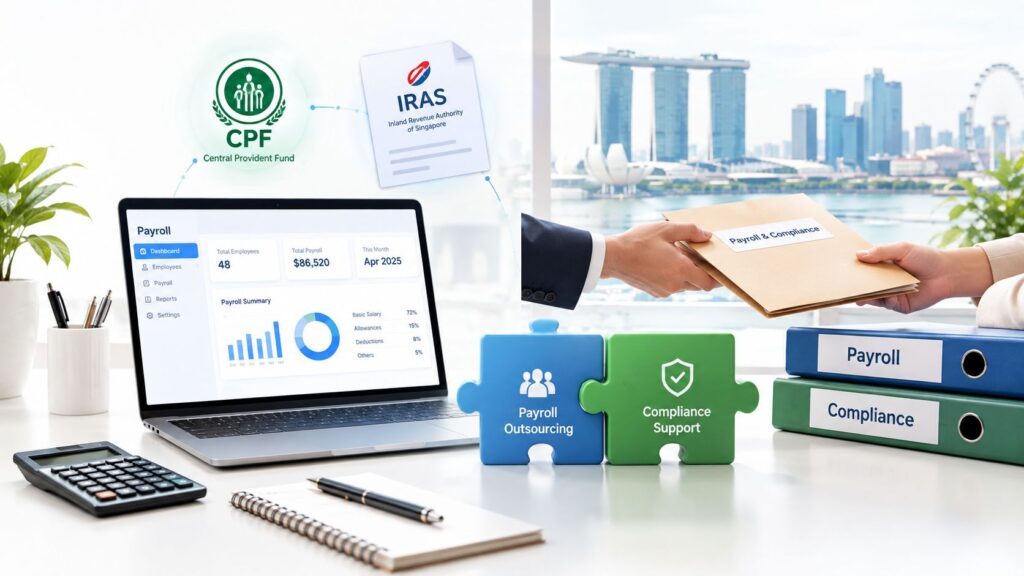
A payroll cycle in Singapore rarely fails because someone forgot to press “run”. It fails because a team member changed, a work pass detail moved, a CPF rate changed, or a filing deadline landed before the spreadsheet was cleaned up. For founders, HR leaders, and finance teams already stretched by hiring and operations, this article looks at payroll as a control environment. It is designed to help employers assess risk, compliance handling, and vendor discipline before deciding how payroll should be managed.
If you are comparing service options, our main Payroll Outsourcing Singapore page covers the commercial side in more detail. This article is intentionally narrower. It focuses on payroll controls, statutory handling, vendor evaluation, and the operational risks that matter when payroll errors affect employee trust and compliance.
When payroll is done well, nobody notices. Salaries land on time, statutory records are aligned, and the business keeps moving. When it is done badly, the problem spreads into employee trust, filing corrections, and avoidable compliance noise that takes longer to unwind than it took to create. That is why the discussion around payroll operations in Singapore has shifted from convenience to governance.
What Singapore Employers Need Payroll Processes to Control
The first payroll run of the month usually begins with a familiar stack of inputs, new joiners, resignations, variable pay, allowances, leave adjustments, and a check against what changed since the last cycle. Then the scope widens. CPF treatment has to be correct, payslips need to be issued properly, records have to match the payroll register, and annual reporting obligations cannot sit in someone’s memory. A clean salary calculation is only the visible layer of the job.
The hidden work behind each monthly cycle
For many growing Singapore employers, the burden is not the pay run itself. It is the chain of small checks that makes the run defensible if anyone asks why a number was set a certain way. A well-run payroll function earns its place because the monthly rhythm stays tied to statutory handling, document control, and exception management, not just salary calculation.
Practical rule: if payroll only works when one person remembers every exception, the process is already too fragile.
For many companies, the practical question is no longer whether payroll can be processed internally. It is whether internal processing still makes sense once the team starts adding local hires, foreign hires, and recurring compliance obligations. PathSource’s Singapore payroll insights make the same point from a different angle, the core issue is who owns the control points, not just who keys in the figures.
CPF, IRAS, and MOM Requirements That Shape Payroll Control
A payroll run in Singapore can look straightforward until three separate compliance tracks start pulling in different directions. CPF affects monthly contribution accuracy. IRAS governs annual reporting discipline and tax clearance in relevant cases. MOM requirements add employer updates that must stay current, or the records start to drift away from the payroll file. Each track has its own timing and its own failure points, which is why internal generalists often underestimate the workload.
CPF is not a fixed-rate exercise
The official CPF table for 1 January 2026 shows that for employees aged 55 and below, the total CPF rate is 37%, split into 17% employer and 20% employee. For employees above 55 to 60, the total is 34%, split into 16% employer and 18% employee. For employees above 60 to 65, the total is 25%, split evenly at 12.5% each (CPF Board). The official 2026 contribution tables also confirm that the framework applies to monthly wages above $750 and should be read from the current tables, not older guidance (CPF 2026 table).
The wage ceiling context matters too. CPF Board states that the Ordinary Wage ceiling is S$8,000 per month from 1 January 2026, the final step in the phased increase, while the annual wage ceiling remains S$102,000 (CPF Board OW ceiling, CPF 2026 changes).
That matters because payroll teams must calculate and remit CPF correctly every month, and the rate logic changes with age band, wage level, and current ceiling settings. A provider that only processes salaries, without handling statutory updates cleanly, leaves the most error-prone work inside the business.
IRAS reporting rewards automation, not memory
Annual reporting is where manual payroll processes often start to show strain. Employers must prepare employee income information by 1 March each year. Employers under the Auto Inclusion Scheme (AIS) submit the information electronically to IRAS, while employers not under AIS generally provide Form IR8A and the relevant appendices to employees rather than submitting the hardcopy forms to IRAS. For employers on the Auto Inclusion Scheme (AIS), submissions are made electronically to IRAS, and IRAS states AIS is mandatory for employers with 5 or more employees in the relevant year, or where the employer receives a notice to file electronically (IRAS reporting employee earnings, IRAS AIS submission).
Tax clearance can add another layer. IRAS requires employers to file Form IR21 at least 1 month in advance for relevant non-Singapore citizen employees and to withhold monies due once the employer knows the employee is ceasing employment, going on overseas posting, or leaving Singapore for more than three months (IRAS tax clearance).
For a closer look at how the filing flow works, see our overview of the Auto Inclusion Scheme and the underlying filing requirement at IRAS. The point is not that software replaces judgment. The point is that statutory automation cuts avoidable friction across the monthly and annual cycle.
Payroll becomes easier when the system can push the right information into the right statutory channel without a second round of manual typing.
MOM updates extend payroll discipline into HR operations
MOM’s Employment Pass rules add another compliance layer that payroll-adjacent teams often inherit. Employers must ensure their organisation’s turnover information for the past 3 years is updated before submitting an EP application, and they must have fairly considered all jobseekers (MOM EP apply page).
MOM also requires employers to notify changes to an EP holder’s salary, residential address, or mobile number. A salary reduction request must be submitted at least 1 month before the intended change date, while address or mobile updates must be made within 5 days (MOM change notification page).
That is why payroll oversight in Singapore cannot stay limited to finance administration. It affects work pass records, employee data control, and the employer’s ability to keep statutory files aligned without building an oversized internal team.
Why This Matters in Vendor Evaluation
A small payroll error in Singapore can ripple into CPF, reporting, and employee records fast. That is why outsourced payroll earns its keep as a control function. It gives smaller HR and finance teams a structured way to reduce error risk, manage updates, and preserve auditability without building every compliance edge case in-house.
Control matters more when the team is lean
Lean teams can keep payroll moving until the first serious exception appears, a late change, a correction after approval, or an employee record that no longer matches the expected statutory treatment. Then the cost is not only time. It is the pressure of checking whether one mistake has affected CPF underpayment, late reporting exposure, or a pay dispute.
Outsourcing works best when it removes the fragile parts of the process, not just the repetitive ones. A provider should handle document intake, statutory calculation, approval routing, and filing support in a way that keeps the workflow auditable. A clean handoff matters more than a lower fee if the lower fee still leaves the business carrying the risk.

Mixed workforces increase the need for process discipline
The control argument becomes stronger when a company hires locals and foreigners together. Payroll then sits alongside pass administration, salary updates, and employer record maintenance. Beyond processing compensation, the business is managing a regulated operating environment where each change may have downstream implications for filings or records.
For some employers, that makes outsourcing a governance decision. The value is consistency. When payroll, statutory reporting, and record changes move through one disciplined process, the business gets clearer line of sight across HR and finance.
Useful test: if the provider cannot explain how an exception moves from intake to correction, the provider is not really managing payroll control.
How to Assess Payroll Technology and Governance
A payroll provider can present a polished front while the actual workflow stays manual. Employers need to assess technology depth and governance posture, because those two areas determine whether the provider can handle Singapore payroll as a control function, not just a processing task.
What strong provider assessment should cover
| Evaluation Factor | Why It Matters |
|---|---|
| Statutory automation | Direct filing support reduces rekeying and lowers error risk across CPF, IRAS, and tax-clearance workflows. |
| Update discipline | Payroll tables and filing logic must keep pace with current statutory changes, not old settings. |
| Audit trail quality | Employers need to see who changed what, when it changed, and how the final figure was approved. |
| Governance and transparency | Clear controls matter more as payroll links to broader corporate services oversight. |
| Exception handling | A good provider can explain how salary changes, new joiners, and leavers move through the process without gaps. |
The governance issue has become sharper in 2025, but it should be framed carefully. The Corporate Service Providers Act 2024 took effect on 9 June 2025, and ACRA states that registration applies to businesses carrying on regulated corporate services as defined under the regime, not to payroll processing as an automatic category by itself (ACRA CSP overview, ACRA CSP registration). For payroll vendor assessment, the safer question is whether the provider’s wider service model creates any regulated obligations, and whether those obligations are understood and handled transparently.
A useful test is to ask for a live correction example. A salary change submitted after cut-off is a good one. A capable provider should be able to show the logged intake, approval path, recalculation, and final payroll impact without hesitation. If that trail is hard to produce, the control design is weak.
The right questions are practical, not decorative
Employers should ask how exceptions are logged, who approves overrides, and what happens when a filing needs correction after processing. A provider that runs payroll through structured controls is usually better suited to growth than one that depends on informal memory and email chains.
One option in this space is PathSource Consulting, which supports payroll outsourcing alongside Employment Pass and HR setup for companies building teams in Singapore. That matters because payroll rarely sits alone for long. It usually becomes part of a broader operating requirement.
Pricing Should Be Read Through a Risk Lens
Payroll outsourcing pricing is usually easier to understand once the buyer stops asking only, “What is the monthly fee?” and starts asking, “What is included, what changes extra, and where does the provider keep responsibility?” The common models are straightforward, a per-employee-per-month structure or a flat monthly retainer. What matters is not the label but whether the fee matches the level of service and control the business needs.
What employers should budget for
A transparent proposal should show how the provider handles setup, monthly processing, amendments, off-cycle runs, and support for statutory changes. Hidden complexity tends to surface in edge cases, not in the standard monthly run. If every exception is treated as a new charge, the initial price may no longer reflect the actual cost of ownership.
A common misconception is that outsourcing is always cheaper than in-house payroll. That is not automatically true. For a very small team, value may be compliance discipline and process clarity, not direct cost reduction. For a growing business, outsourcing can also avoid the need to build internal capacity for each new statutory wrinkle.
Price only matters after control is clear
If an internal team can manage payroll accurately and keep pace with regulatory change, outsourcing may not be urgent. If payroll has started to depend on one overburdened person, or if the business is adding foreign hires, the price comparison changes quickly. The cheapest option is not useful if it cannot keep up with filing discipline, record accuracy, and update timing.
Simple benchmark: price only matters after the provider has shown how they will keep payroll accurate, current, and reviewable.
A Practical Decision Framework for Employers
The cleanest way to assess payroll outsourcing is to start with the actual operating reality, headcount mix, hiring plans, foreign worker exposure, and how much internal time is already being spent on salary administration. Once those facts are clear, the employer can decide whether the priority is payroll processing alone or a broader package that also covers pass support and HR setup. The decision should follow the business, not the other way around.
A useful selection sequence
First, define which payroll tasks must remain visible to the business and which can move to a provider. Next, confirm how the vendor handles statutory updates, approvals, and reporting. Then check whether the provider can support the rest of the employment lifecycle without forcing separate workarounds for onboarding, pass changes, or HR documentation.
For companies that are setting up or expanding in Singapore, Employment Pass and HR setup support is often part of the same conversation as payroll, because new hires and work pass records usually affect the payroll process too. The right support model is the one that keeps records aligned as the team grows.
A practical approach is to treat payroll as part of workforce infrastructure, not an isolated admin task. Once that shift happens, it becomes easier to choose a provider on the basis of fit, compliance discipline, and responsiveness rather than on price alone.
PathSource Consulting supports Singapore employers with payroll outsourcing, Employment Pass and HR setup, and specialist recruitment for growing teams. If your business needs payroll support that fits into hiring and compliance planning, visit PathSource Consulting to discuss your requirements.