

A Singapore employer has approved a critical technology, engineering or transformation project, but the required specialist is only needed for a defined phase. The permanent headcount request is difficult to justify, while an internal search may not move quickly enough to meet the implementation date. At the same time, hiring a contractor without understanding payroll, work-pass and licensing responsibilities can create avoidable operational risk.
A contract recruitment agency can help solve that tension, but contract hiring works best when it is treated as a workforce decision rather than a faster version of job advertising. The right model depends on the role's duration, urgency, skill scarcity, reporting structure and likely future value to the business.
When Contract Hiring Makes Sense in Singapore
A Singapore company is preparing a systems implementation that depends on a specialist who understands a particular technology environment, can work with internal stakeholders and can contribute immediately. The role may be business-critical during delivery, yet its value may change once implementation and stabilisation are complete. That is a workforce design question, not a faster recruitment request.
Permanent search remains appropriate when the specialist capability will become part of the organisation's long-term operating model. Contract hiring fits better when funding is approved for a defined project, the required skills may change after delivery, or temporary cover is needed while the permanent structure is being finalised. It gives the employer access to scarce capability while preserving time to assess whether the role should become permanent, move to an embedded recruitment model, or end with the assignment.
Singapore's labour market is monitored through nationwide surveys and administrative records covering employment, vacancies, turnover and recruitment activity, as explained by the Ministry of Manpower's labour-market statistics. The 2Q2026 Labour Market Report recorded job vacancies falling from 73,300 in March 2026 to 68,600 in June 2026, with the decline mainly affecting PMET vacancies in Financial Services and Information & Communications. The practical point is that demand can shift within higher-skilled segments. Employers should therefore test the hiring route against the project's actual capability requirement instead of assuming that permanent headcount is always the safer choice.
Practical rule: Use contract recruitment when the business can define the assignment, the expected contribution and the point at which the requirement will be reviewed.
Urgency can change the decision. The official MOM Labour Market Report for 2Q 2026 noted that 48.7% of firms intended to hire in the next three months in July 2026, up from 43.9% in June. That points to a positive but still cautious hiring outlook. The practical implication is the same: time-to-fill matters when a delay could affect revenue, compliance deadlines, a product launch or a customer commitment. The employer should weigh that urgency against assignment clarity, likely duration and the compliance work required before the contractor starts.
What a Contract Recruitment Agency Actually Does
A contract recruitment agency does more than publish a vacancy. It converts a defined business requirement into an assignment, identifies suitable candidates, evaluates their fit and coordinates the administrative process that allows the person to start and remain engaged.
The work usually includes:
- Role definition: The agency clarifies the deliverables, duration, required skills, reporting arrangements, working location and reasons for the contract structure.
- Candidate sourcing: Recruiters approach relevant candidates, including people who may not respond to general advertising but are open to a defined project or specialist assignment.
- Assessment: The agency tests experience against the actual work. A strong CV isn't enough if the candidate hasn't handled the systems, stakeholders or delivery conditions involved.
- Placement coordination: The agency manages interviews, feedback, offer discussions, assignment documentation and start-date planning.
- Ongoing administration: Depending on the arrangement, the agency may coordinate payroll, salary disbursement, timesheets, onboarding documentation, renewals and offboarding.
The distinction between advertising and placement matters in Singapore. MOM states that a business must hold an Employment Agency licence if it places job seekers with employers, communicates with job seekers about employment applications, collates resumes to establish an employer-employee relationship, submits work pass applications, or helps place job seekers with employers. The requirement applies to placements in Singapore and overseas, while a business recruiting only for its own organisation doesn't require an EA licence, as set out in MOM's guidance on who needs an Employment Agency licence.
That means employers should ask what the agency will do, not rely on labels such as “talent partner”, “staffing provider” or “recruitment platform”. An agency handling regulated placement activity or work-pass facilitation needs the correct licence and operating controls.
For specialist requirements, an employer should also distinguish between a recruiter who forwards resumes and a consultant who understands the work. Specialist recruitment support from PathSource Consulting is structured around role understanding, candidate evaluation and consultative advice for specialist and business-critical hiring. Employers comparing providers can also review what a broader recruitment agency in Singapore should cover before selecting a contract hiring partner.
Contract Versus Permanent Recruitment in Singapore
Contract and permanent recruitment solve different workforce problems. Permanent recruitment is designed for an ongoing employment relationship. The employer usually owns the long-term development of the employee, carries the employment administration and expects the person to build institutional knowledge over time.
Contract recruitment is designed around a defined assignment or a period of uncertain demand. The employer may gain faster access to a specific capability, while the agency may remain responsible for the employment relationship, payroll process and related administration, depending on the agreed structure. That can reduce the client's internal workload, but it doesn't remove the need for clear governance.
| Decision factor | Contract recruitment | Permanent recruitment |
|---|---|---|
| Business need | A project, interim requirement, temporary gap or uncertain headcount plan | An enduring position that supports the organisation's long-term structure |
| Workforce commitment | The assignment has a defined term or review point | The employer commits to an ongoing employment relationship |
| Skill requirement | Immediate, specialist execution may matter most | Capability development, continuity and institutional knowledge may matter most |
| Payroll position | The worker may remain on the agency's payroll, subject to the agreed model | The worker generally joins the client's payroll |
| Cost logic | The client pays for the assignment and associated administration | The client carries ongoing employment and workforce costs |
| Main risk | Ambiguous scope, weak administration or poor knowledge transfer | A long-term mismatch, slow replacement or premature headcount commitment |
The payroll distinction needs careful attention. An agency payroll model can simplify monthly administration for a lean employer, but the client still needs to understand who approves timesheets, who handles salary disbursement, who manages leave and who coordinates statutory obligations. A contract arrangement that leaves those responsibilities unclear will create friction at the first payroll cycle. Where payroll administration is likely to sit outside the client's internal HR capacity, payroll outsourcing in Singapore can help define ownership, controls and monthly processing responsibilities.
An embedded model is different again. The recruiter works as an extension of the internal hiring function, supporting a continuing flow of roles rather than placing one contractor for one project. Recruitment process outsourcing in Singapore can be relevant when the employer needs sustained recruitment capacity but isn't ready to build a full internal talent acquisition team.
A short assignment can justify contract hiring. A permanently recurring requirement usually deserves a fresh review of whether the organisation is avoiding a permanent decision it actually needs to make.
Permanent recruitment remains more appropriate when the role owns long-term relationships, sensitive intellectual property, business continuity or a capability the organisation will repeatedly need. Contract hiring is more appropriate when the assignment can be measured by deliverables and the business has a credible plan for handover, extension or closure.
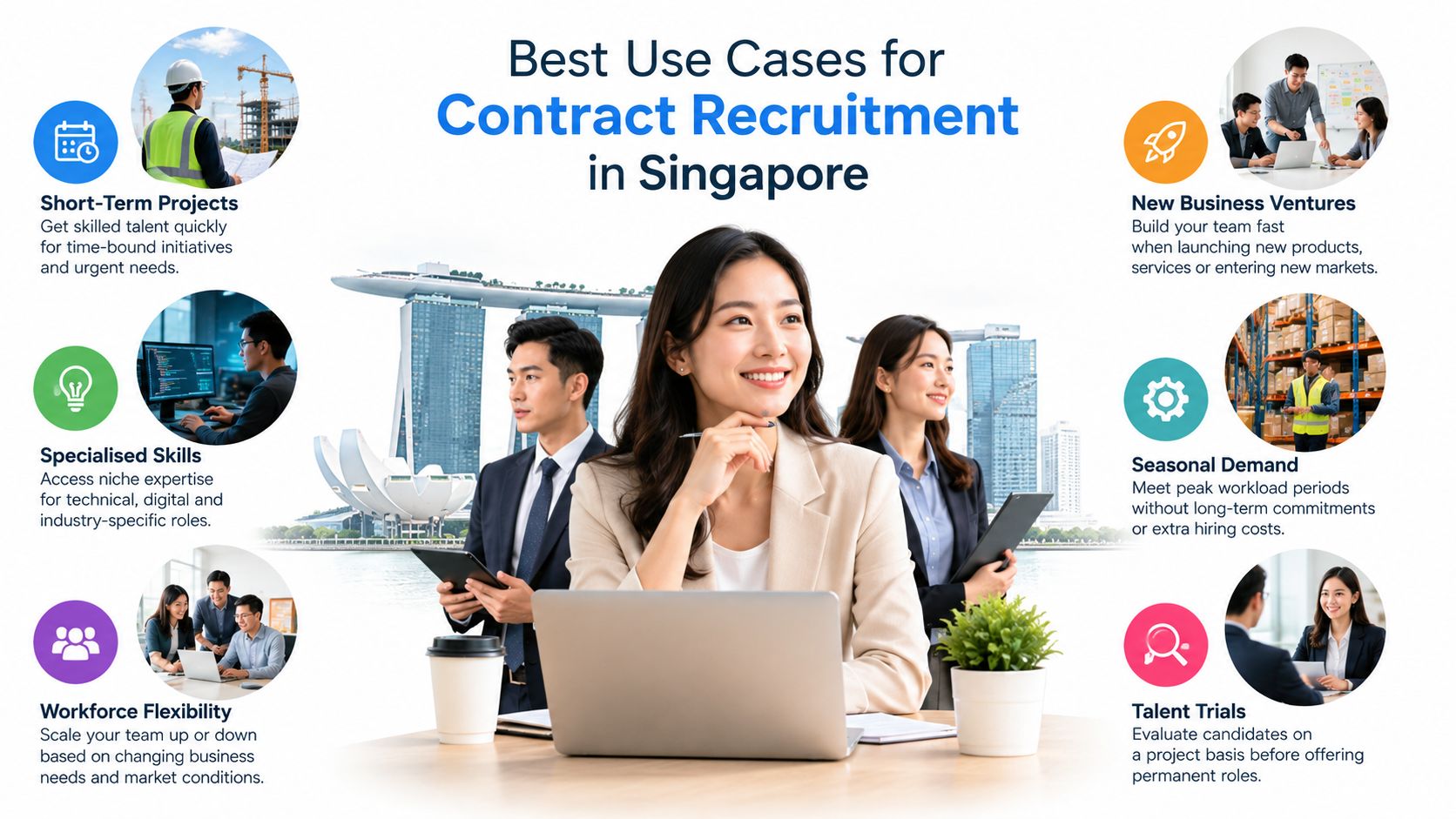
Best Use Cases for Contract Recruitment in Singapore
Contract recruitment is most useful when the employer can explain why the capability is needed now and what will change after the assignment. A role shouldn't become contractual just because the hiring manager wants a faster process. The structure should reflect the work.
Project delivery and transformation
Technology implementation, data migration, cyber initiatives, process redesign and regional transformation often require specialist capability for a defined phase. A contract specialist can focus on delivery while the internal team retains ownership of the operating model and future requirements.
The arrangement works when the employer defines:
- The deliverable: What must be completed, implemented, stabilised or transferred.
- The decision owner: Which internal leader approves work and resolves competing priorities.
- The knowledge-transfer point: What documentation, training or handover must exist before the assignment ends.
Interim leadership and critical cover
A contract appointment can provide continuity when a senior employee leaves, takes extended leave or becomes unavailable during a sensitive period. This is particularly relevant for finance, operations, compliance, technology and transformation functions where an unfilled leadership gap can delay decisions across the organisation.
Interim coverage shouldn't be treated as a substitute for a permanent search if the position is central to the company's long-term direction. The contract can stabilise the function while the employer runs a properly scoped permanent process.
Scarce specialist skills
Employers in technology, financial services, engineering, manufacturing, pharma and semiconductors may need expertise that is difficult to maintain internally between projects. Contract recruitment can provide access to a specialist who has already handled a comparable environment, subject to proper assessment and work-authorisation checks.
The trade-off is continuity. A contractor may deliver quickly but leave with valuable context unless the client documents decisions, systems and processes during the assignment. A permanent hire may take longer to become productive but can accumulate knowledge that strengthens the organisation over time.
Choosing among three models
A simple decision test helps:
- Contract recruitment fits an urgent, defined assignment with a clear end point or review stage.
- Embedded recruitment fits continuing hiring activity where the business needs additional internal capacity.
- Permanent search fits a role that will remain strategically important after the immediate project ends.
Singapore's total foreign workforce was 1,655,900 in June 2026, according to MOM's official foreign workforce figures. Employers using overseas specialist talent should therefore assess work-pass administration as part of the delivery model, not as paperwork to be considered after the candidate accepts.
Regulatory and Operational Considerations
The first control is licence verification. In Singapore, the relevant activity determines whether an Employment Agency licence is required. The licence scope also matters. MOM currently recognises four licence types: Comprehensive Licence (All), Comprehensive Licence (Local), Comprehensive Licence (non-FDW) and Select Licence. A Select Licence applies only where placed workers earn more than S$4,500 per month. The three Comprehensive licence types do not all cover the same worker categories, so employers should confirm that the agency's licence matches the planned worker group and assignment structure, as set out in MOM's Employment Agency licence guidance.
The licence affects the agency's operating model. MOM's application guidance states that the relevant key appointment holder must apply, and that certain authorised roles and eligibility requirements apply. CEI certification applies to agencies holding a Comprehensive Licence, but it is not required for Select Licence personnel, according to MOM's CEI requirements. The agency's ACRA profile must also use the relevant business-activity classification, including SSIC 78103 for domestic worker placement agencies or SSIC 78104 for employment agencies. A licence can be issued for up to three years, with upfront and issuance payments of S$400 and S$100 respectively, according to MOM's licence application guidance.
Employer check: Confirm the agency's licence class, registered business activity and ability to support the worker category before a contract assignment begins.
Payroll is the second control. CPF Board states that employers must pay CPF contributions for Singapore Citizens and Singapore Permanent Residents earning more than S$50 per month. For wages above S$750, the employer rates listed by age band are 17% for those aged 55 and below, 16% for those above 55 to 60, 12.5% for those above 60 to 65, 9% for those above 65 to 70 and 7.5% for those above 70. The CPF contribution guidance also explains separate arrangements for Singapore Permanent Residents during their earlier years of membership.
The agency or payroll provider must therefore maintain accurate records of citizenship or PR status, age band, wage components and contribution timing. Employers should ask how payroll data is checked, who approves monthly inputs, how salary disbursement is coordinated and what happens when the assignment changes.
Work-pass support adds another layer. If the agency communicates with candidates about applications or submits work-pass applications on behalf of the employer or candidate, that activity falls within the regulated perimeter described earlier. The employer should agree who prepares documents, who checks eligibility, who communicates with MOM and who owns the timeline. A contract can be commercially attractive yet operationally unsuitable if work-pass dependencies aren't built into the start-date plan.
How to Select and Manage a Contract Recruitment Partner
Cost and speed are useful filters, but they shouldn't decide the appointment alone. A reliable partner must show that it understands the role, can assess specialist candidates and has a disciplined process for payroll, documentation, renewals and assignment closure.
A practical selection conversation should cover:
- Licence scope: Which licence does the agency hold, and does it cover the planned worker category?
- Assessment method: How will the recruiter test technical capability, communication, judgement and the requirements specific to the assignment?
- Employment model: Who employs the contractor, processes payroll, coordinates statutory obligations and manages work-pass administration?
- Assignment control: Who handles performance concerns, absence, extension discussions and early termination?
- Commercial terms: How are bill rates, payroll costs, invoicing, conversion arrangements and notice provisions documented?
The agency should also explain what happens after placement. Contract staff need a named client manager, defined objectives, access permissions, a feedback route and a clear offboarding process. A recruiter who disappears after the start date may still have filled the vacancy, but the employer has inherited the relationship-management burden.
For organisations with recurring hiring requirements, an embedded arrangement may make more sense than separate searches. For one defined assignment, a specialist contract placement may be more efficient. For a confidential or business-critical permanent appointment, employers can compare engagement structures through retained and contingency recruitment before choosing the commercial model.
Managing the assignment
The client should document the following before the contractor starts:
- Scope and success measures, including the work the contractor owns and the work that remains with the internal team.
- Reporting and approvals, including timesheets, leave, expenses, system access and escalation routes.
- Review points, where the client evaluates delivery, extension needs and knowledge transfer.
- Exit arrangements, including notice, return of equipment, access removal, records handover and stakeholder communication.
The strongest partner relationships are consultative. They give the employer a clear recommendation when contract hiring is appropriate, and they also say when permanent recruitment or embedded support would better fit the underlying need.
Next Steps for Singapore Employers
Start with the business problem, not the employment label. A specialist needed to deliver a defined project may suit contract recruitment. If the work is likely to continue indefinitely, a temporary appointment can delay a broader workforce decision.
Before approaching a provider, clarify three points:
- What must be delivered, and by when?
- How long will the capability remain necessary after delivery?
- Who will manage recruitment, payroll, work-pass coordination and employment administration?
These questions separate a genuine contract requirement from a permanent role with an uncertain start. They also show whether the organisation needs a placement, continuing recruitment capacity or operational HR support.
A company establishing a Singapore operation may require several forms of help. Recruitment can identify specialist talent, an embedded arrangement can provide ongoing hiring capacity, payroll outsourcing can handle recurring administration, and HR setup can establish documentation and processes for a growing team. Match each service to the organisation's stage, internal capability and expected hiring volume rather than bundling them by default.
The same assessment applies to a senior or specialist appointment. Contract hiring can place capability against a defined business need while the employer tests the role's long-term shape. Permanent search is more appropriate when the position clearly belongs in the enduring organisation design and continuity matters from the start.
Employers can monitor vacancies and recruitment activity through Singapore's MOM labour-market data, including movement in higher-skilled areas. The official labour-market statistics provide useful market context, but they cannot determine the right response to a specific role. Urgency, talent scarcity, assignment duration and compliance responsibilities still require role-level judgement.
Whichever model is chosen, the decision should end with a written scope, a named owner for administration and a confirmed handover plan.
PathSource Consulting supports Singapore employers with founder-led executive and specialist recruitment, contract and project-based hiring support, payroll outsourcing, Employment Pass and work-pass coordination, HR setup and flexible workforce planning. Employers considering contract recruitment, embedded support or permanent search can discuss their requirements by visiting PathSource Consulting.