

The role has been live for weeks. Applications keep arriving, but most miss the technical depth, leadership scope or Singapore market context the business needs. The hiring manager is spending evenings screening CVs, the founder is delaying a key decision, and the team is absorbing work that should belong to the new hire.
That situation is often described as a sourcing problem. It usually isn't. For specialist and senior hiring, the harder question is whether the employer has designed a credible search and evaluation process. A useful headhunter in Singapore should widen access to relevant people, but the value lies in defining the mandate, testing capability and exposing risks before an offer is made.
When Posting a Job Ad Stops Working in Singapore
A job advertisement works well when the role is clearly understood, the skills are reasonably available and suitable candidates are actively looking. It becomes less effective when the employer needs a passive candidate, a rare technical combination or a person trusted with a business-critical decision.
Consider a manufacturing company searching for an engineering leader who has managed complex operations, understands regulated environments and can work with regional stakeholders. The advertisement may attract people with one or two relevant keywords, but not necessarily someone who has delivered the required outcomes. The strongest prospects may already be employed, may not be monitoring advertisements, or may be cautious about signalling that they're open to a move.
MOM's first-quarter 2026 labour market report
Singapore's labour market reinforces that challenge without supporting a simplistic “talent shortage everywhere” narrative. The Ministry of Manpower recorded 68,600 job vacancies in June 2026, with a vacancy-to-unemployed ratio of 1.48, while 17.1% of all vacancies in 2025 remained unfilled for at least six months. For PMET vacancies, the share rose from 14.4% in 2024 to 16.0% in 2025. Those figures are reported in MOM's second-quarter 2026 labour market report.
The point at which advertising stops being the main strategy
An employer should consider external search when several of these conditions appear together:
- The role is business-critical: A prolonged vacancy is affecting revenue, delivery, compliance or expansion.
- The specification is narrow: The position needs a combination of domain knowledge, leadership judgement and practical technical ability.
- The target candidates are passive: The people worth meeting aren't responding to public adverts.
- The shortlist keeps repeating itself: Applications produce similar CVs rather than a credible range of profiles.
- Confidentiality matters: The employer can't publicly disclose a replacement, restructuring plan or market entry.
- The internal team lacks capacity: Hiring managers can assess candidates but don't have the time to map the market and conduct disciplined outreach.
The answer isn't automatically to appoint a headhunter. First, the hiring manager should test whether the brief is realistic, the compensation is competitive and the interview process is fast enough to keep credible candidates engaged.
Practical rule: If the business can't explain what success looks like in the first year, no search partner can reliably identify the right person.
A specialist headhunter becomes useful when the employer needs search design, not just more applications. That means translating an ambiguous brief into observable outcomes, identifying adjacent talent pools, approaching people discreetly and giving the decision-makers evidence rather than a stack of CVs. Employers comparing providers can also review a broader recruitment agency in Singapore option before deciding whether a specialist search mandate is necessary.
What a Headhunter Actually Does for Singapore Employers
A headhunter earns their fee by improving the hiring decision, not by forwarding a larger pile of CVs. The work has three connected parts: mandate definition, candidate outreach and structured evaluation.
The mandate is tested before sourcing begins. A credible search partner should challenge the job title, clarify reporting lines, separate requirements from preferences and define what the successful hire must change or deliver. For an operations role, that means distinguishing experience in a particular sector from the broader ability to improve processes, lead teams and manage stakeholders.
The search then moves into the market. A headhunter approaches people who may not be applying publicly, explains the opportunity well enough to earn a conversation and tests whether the candidate's motivations fit the move. Discretion matters when the employer's identity or the reason for the search cannot be disclosed immediately.

Evaluation should test capability, not presentation
Singapore employers should be cautious about credential-heavy screening. In 2025, employers prioritised relevant experience for 48.2% of vacancies and skills and abilities for 20.1%, while academic qualifications were the top-ranked hiring factor for 9.4% of vacancies. Separately, academic qualifications were not the main consideration for 79.6% of vacancies, according to MOM's job vacancies data.
A useful evaluation tests four points:
- What did the candidate personally deliver? Separate titles and team achievements from direct responsibility.
- How was the result achieved? Ask about decisions, constraints, trade-offs and stakeholder involvement.
- Can the capability transfer? Someone from an adjacent sector may offer stronger problem-solving evidence than a candidate with a perfect title match.
- What would expose a risk? Structured questioning, references and practical work samples can test weaknesses hidden by a polished CV.
The headhunter should also explain the operating model. Retained executive search usually starts with a defined mandate, deeper market mapping, senior consultant involvement and staged payments. Contingent search gives the employer more flexibility and charges on successful placement, but the employer should confirm the expected search depth and how candidate ownership will be managed. Embedded recruitment or Recruitment-as-a-Service adds ongoing hiring capacity within the employer's process.
These arrangements do not guarantee retention or performance. They give the employer different levels of support and discipline when making a hiring decision.
Advertising, Embedded Recruitment and Search Compared
There isn't one correct hiring model for every Singapore role. The right choice depends on scarcity, seniority, confidentiality, business impact and internal capacity.
Advertising is usually the sensible first route for roles with a clear market, a broad candidate pool and a process the internal team can manage. It gives the employer control over the message and can produce useful inbound interest. It won't, by itself, reach every qualified passive candidate or resolve a poorly designed brief.
Embedded recruitment suits an employer with recurring hiring needs but limited internal talent acquisition infrastructure. The recruiter works within the organisation's workflow, supports several vacancies and helps create consistency across sourcing, screening and coordination. The trade-off is commitment. The employer needs to provide access, decisions and clear priorities.
Contingent search is more suitable when the employer wants external reach without commissioning a highly exclusive assignment. It can work for specialist roles where the specification is clear and multiple agencies may be engaged, but the employer should ask how candidate ownership, duplication and assessment quality will be managed.
Retained search is designed for senior, confidential or particularly consequential appointments. The employer pays for a dedicated process rather than only for the final event of hiring. That can support more deliberate market mapping, direct engagement and advisory input, but it requires alignment between the client and search partner from the outset.
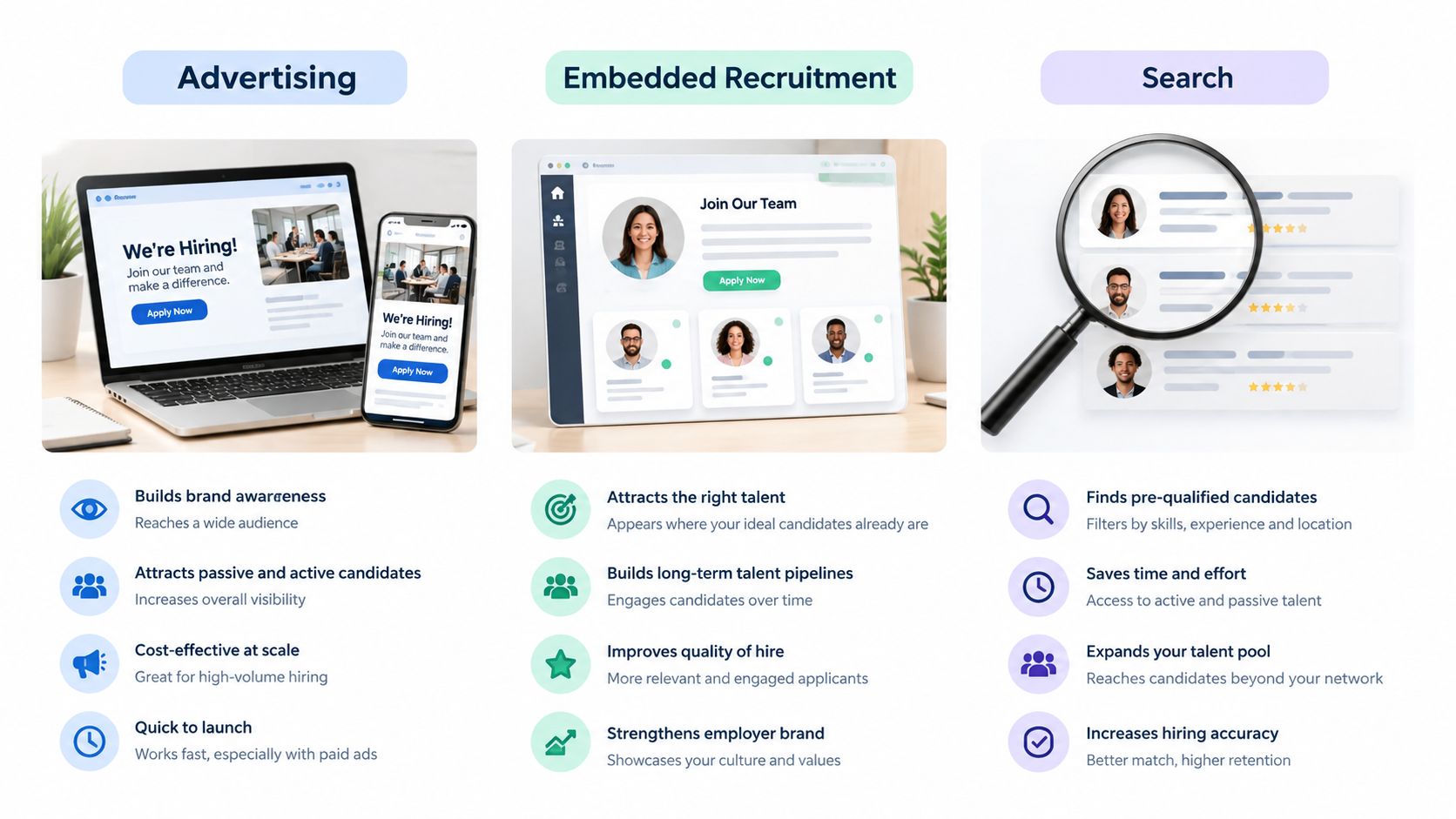
Choosing the right hiring model in Singapore
| Model | Best fit roles | Typical cost basis | Confidentiality | Employer time |
|---|---|---|---|---|
| Advertising | Clearly defined roles with an accessible candidate pool | Advertising and internal hiring costs | Low to moderate | Moderate |
| Embedded recruitment | Ongoing hiring across several roles | Agreed project or ongoing service fee | Moderate | Shared with the embedded team |
| Contingent search | Specialist roles where flexibility matters | Fee on successful hire | Moderate | Moderate |
| Retained executive search | Senior, confidential or business-critical appointments | Retainer and staged search fees | High | High involvement at key decisions |
The practical decision is straightforward. Use advertising when the market is visible. Use embedded support when hiring volume or continuity is the issue. Use contingent search when external reach is needed without a fully dedicated mandate. Use retained search when the appointment deserves a controlled, confidential and consultative process.
An employer shouldn't choose a model because it sounds prestigious. It should choose the model that matches the cost of a wrong hire and the amount of internal attention the search can receive.
Fee Models, Timelines and Replacement Terms in Singapore
A low percentage does not make a search inexpensive. If the consultant forwards unsuitable CVs, your team pays in interview time, management attention and the cost of delaying the appointment. Judge the fee against the evaluation work you need, not the headline rate.
Singapore engagements generally use three commercial structures. A percentage fee is calculated against an agreed definition of annual remuneration. A fixed fee gives clearer cost control when the role and search scope are well defined. A staged retained arrangement spreads payment across the assignment start, a defined search milestone and the appointment, or another agreed stage.
Contingent search normally makes payment dependent on a successful hire. It can suit a role with an accessible candidate pool and a flexible process. It deserves closer scrutiny when the position is confidential, the talent pool is narrow or the employer needs structured assessment rather than CV forwarding. The agreement should state whether the consultant commits dedicated time, whether several agencies may submit the same candidate and whether the fee applies if that person joins in a different role. The trade-offs between retained and contingency recruitment should be assessed against the assignment, not treated as a matter of prestige.
The contract should answer these points plainly:
- Fee basis: Does remuneration include base salary, guaranteed payments or other agreed components?
- Payment trigger: Is payment due on acceptance, commencement or another specified event?
- Replacement provision: What happens if the hire leaves during the agreed replacement period?
- Refund terms: Does the employer receive a refund, or will the partner conduct another search?
- Candidate ownership: How long does ownership last, and what happens if the employer already knows the candidate?
- Search scope: Which locations, sectors, competitors and adjacent talent pools will be covered?
- Interview support: Who coordinates interviews, gathers feedback and assists with offer discussions?
- Work pass coordination: Is Employment Pass or other work pass support included, or charged separately?
Replacement terms deserve particular attention. A replacement search is useful only if it covers a comparable role, starts promptly and does not trigger another full fee. Confirm whether the provision is suspended when the employer changes the role, compensation or reporting line. Also check whether resignation, dismissal, redundancy and misconduct are treated differently.
Timelines should be written as working assumptions, not promises. Brief refinement, candidate availability, several engagement conversations, interview feedback, notice periods and compensation negotiations can each delay a start date. Work pass processing may add another dependency for a foreign hire. Agree who owns each decision and how quickly feedback is expected, because silence from the hiring team can stall even a well-run specialist search.
Employment Pass and Work Pass Considerations for Senior Hires
A senior candidate may be an excellent fit and still fail the work pass check. Test that feasibility before an offer, using the candidate's age, sector, proposed salary and COMPASS profile. Leave it until the end, and salary negotiations may be built around an assumption the employer cannot support.
For an Employment Pass, start with the qualifying salary requirement, which varies by age and sector. Unless an exemption applies, the candidate must also pass the Complementarity Assessment Framework, or COMPASS, with at least 40 points.
For new applications from 1 January 2025, the qualifying salary starts at S$5,600 per month in most sectors and S$6,200 in financial services. These thresholds apply to renewals from 1 January 2026. For candidates aged 45 and above, the qualifying salary reaches S$10,700 in most sectors and S$11,800 in financial services, according to MOM's Employment Pass eligibility guidance.
Test eligibility while the role is still being shaped
Build the work pass review into the first serious candidate assessment. Record the candidate's age, business sector, fixed monthly salary, role seniority and occupation, nationality, and current location. These details help the hiring team model the proposed package and identify relocation issues early, while the formal eligibility assessment remains the authority.
The role should be assessed in context rather than by title alone. Review the applicable COMPASS criteria instead of assuming that meeting the salary floor completes the process.
A candidate earning at least S$22,500 in fixed monthly salary is exempt from COMPASS. For other candidates, salary criterion C1 is benchmarked against the 65th percentile of local PMET salaries in the relevant sector. A candidate can therefore meet the general salary requirement and still need sector-specific benchmarking.
MOM has announced that for new applications from 1 January 2027, the minimum is scheduled to rise to S$6,000 outside financial services and S$6,600 in financial services. These thresholds will apply to renewals expiring from 1 January 2028. These are not the current 2026 requirements. Confirm the application date before relying on either threshold.
A search partner can organise candidate information and coordinate documents, but the employer remains responsible for the hiring decision and the accuracy of its assessment. Treat the Employment Pass application process in Singapore as part of the search plan, not paperwork added after salary negotiations.
How to Evaluate and Select the Right Headhunter
The first question for a Singapore employer isn't whether a recruitment firm has a large database. It is whether the consultant can explain how the firm will make this particular search more accurate.
The firm should understand the sector, the operating environment and the outcomes attached to the role. A recruiter who has placed generic titles but can't discuss the technical or commercial context may produce activity without useful judgement.
Questions that reveal search quality
Ask the proposed consultant:
- Who will own the assignment? The person selling the service may not be the person meeting candidates or advising the client.
- How will the role be defined? The consultant should describe the intake process, success outcomes and deal-breaker criteria.
- Which adjacent talent pools will be considered? A narrow title search often misses transferable capability.
- How will candidates be evaluated? Look for structured interviews, evidence-based questioning, relevant work samples and references where appropriate.
- What will the client receive besides CVs? A useful submission should explain motivation, strengths, risks, compensation context and fit against the agreed brief.
- How will candidate communication be handled? Senior candidates judge the opportunity through the quality and discretion of the process.
The agency's regulatory status also matters. MOM requires an Employment Agency licence for organisations that communicate with jobseekers to process applications, collate resumes to help establish an employment relationship, submit work pass applications on behalf of employers or help place jobseekers. The requirement has limited exclusions, including in-house hiring and wholly web-based job portals that don't otherwise match or place candidates, as explained in MOM's licensing guidance for employment agencies.
Red flags that should stop the conversation
- Guaranteed placement claims: No responsible search partner can guarantee that a candidate will accept, perform or remain.
- Vague fees: If the employer can't identify payment triggers, replacement terms and candidate ownership, the agreement isn't ready.
- Unclear role ownership: A senior assignment should have a named accountable consultant.
- CV forwarding without rationale: Volume isn't a substitute for evaluation.
- Pressure to brief multiple roles at once: The consultant may be optimising for activity rather than mandate quality.
- No explanation of candidate approach: Employers should know whether the search relies on advertising, direct outreach, referrals or a combination.
PathSource Consulting is one example of a Singapore-based firm offering founder-led executive and specialist recruitment, alongside payroll outsourcing, Employment Pass support, HR setup and flexible workforce solutions. An employer comparing partners can also review executive search firms in Singapore to clarify the distinction between senior search and general recruitment.
Decision test: The right partner should be able to describe the search process in enough detail that the employer can challenge it before signing.
A Realistic Search Process and What Outcomes to Expect
A well-run specialist search starts with a working session, not a generic job description. The employer and consultant agree on the business problem, reporting relationship, essential capabilities, target background, compensation parameters and interview participants. They also identify what the candidate must accomplish after joining.
The consultant then builds a longlist and tests the market. That stage may reveal that the brief is too narrow, that the target pool sits in an adjacent sector or that the opportunity needs a clearer explanation. A useful partner brings those findings back early instead of sending unsuitable profiles without feedback.
What the employer should expect at each stage
- Intake: The role is translated into outcomes and evidence requirements.
- Market mapping: Potential candidates are identified across direct and adjacent backgrounds.
- Candidate conversations: Motivation, capability, availability and expectations are tested.
- Shortlist presentation: The employer receives a reasoned assessment, not just CV attachments.
- Structured interviews: Decision-makers test the same core competencies while allowing role-specific discussion.
- References and offer: The partner checks concerns, supports communication and helps both sides address practical issues.
- Onboarding handover: The employer receives the information needed for a focused start.
Speed and quality pull in different directions. Moving too quickly can produce shallow evaluation, while delaying feedback can cause suitable candidates to disengage. Founders and senior leaders often add value at the mandate and final-selection stages because they can explain the organisation's direction and make trade-offs that a generic process can't capture.
The headhunter can't remove every hiring risk. The employer still needs to provide accurate information, make timely decisions, assess candidates directly and ensure the role matches the promises made during the search. The useful outcome is a stronger decision process, clearer evidence and fewer avoidable surprises.
PathSource Consulting supports employers with founder-led specialist and executive recruitment, direct involvement in role scoping and candidate evaluation, and related payroll, work pass and HR setup requirements. To discuss a hard-to-fill role or a broader Singapore team build, visit PathSource Consulting and share the hiring context with the team.