
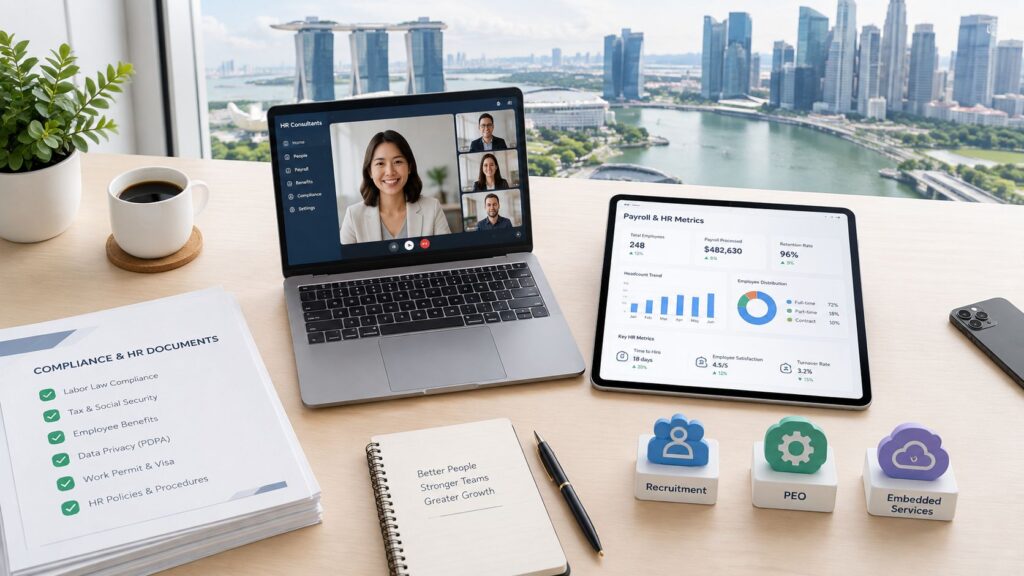
A Singapore employer rarely needs to outsource every HR function at once. More often, one problem starts to slow everything else down. Shortlists arrive too slowly. Payroll reviews take too long. Employment Pass and onboarding documents sit between teams. HR setup exists in pieces, but not as one dependable process.
That is the more useful starting point for this article.
Rather than covering HR outsourcing broadly, this guide focuses on a narrower question: what should Singapore employers outsource first? If you are comparing options at a higher level, the broader HR Outsourcing Solutions for Singapore Employers guide covers the full landscape. This article is designed as a decision framework for employers deciding whether the first priority is specialist recruitment, payroll outsourcing, HR setup and administration, or an integrated support model.
Start With the Bottleneck, Not the Package
A founder, finance lead or operations manager can often keep HR moving for a while. The strain appears when one function begins delaying the rest.
Use this rule first:
Outsource the constraint first. If hiring managers cannot get qualified candidates, prioritise recruitment capacity. If employees are already joining and monthly controls are fragile, prioritise payroll. If the business is still piecing together contracts, onboarding records and work-pass coordination, prioritise HR setup.
This matters because the operating problem is rarely the same across companies:
- A scaling employer may need market-facing hiring support before it needs broader HR administration.
- An established business may already recruit well, but still need tighter payroll controls.
- A new Singapore entity may need contracts, onboarding records, Employment Pass support and payroll handover to work together from day one.
Singapore’s labour market remained tight in 2Q 2026, even as demand moderated. There were 68,600 job vacancies in June 2026, and there were still 1.48 vacancies per unemployed person, according to the Ministry of Manpower’s Labour Market Report for 2Q 2026 and the accompanying official report PDF. That still supports a targeted outsourcing approach, especially where specialist hiring or accurate employee administration is the immediate bottleneck.
The Four Functions Singapore Employers Commonly Outsource First
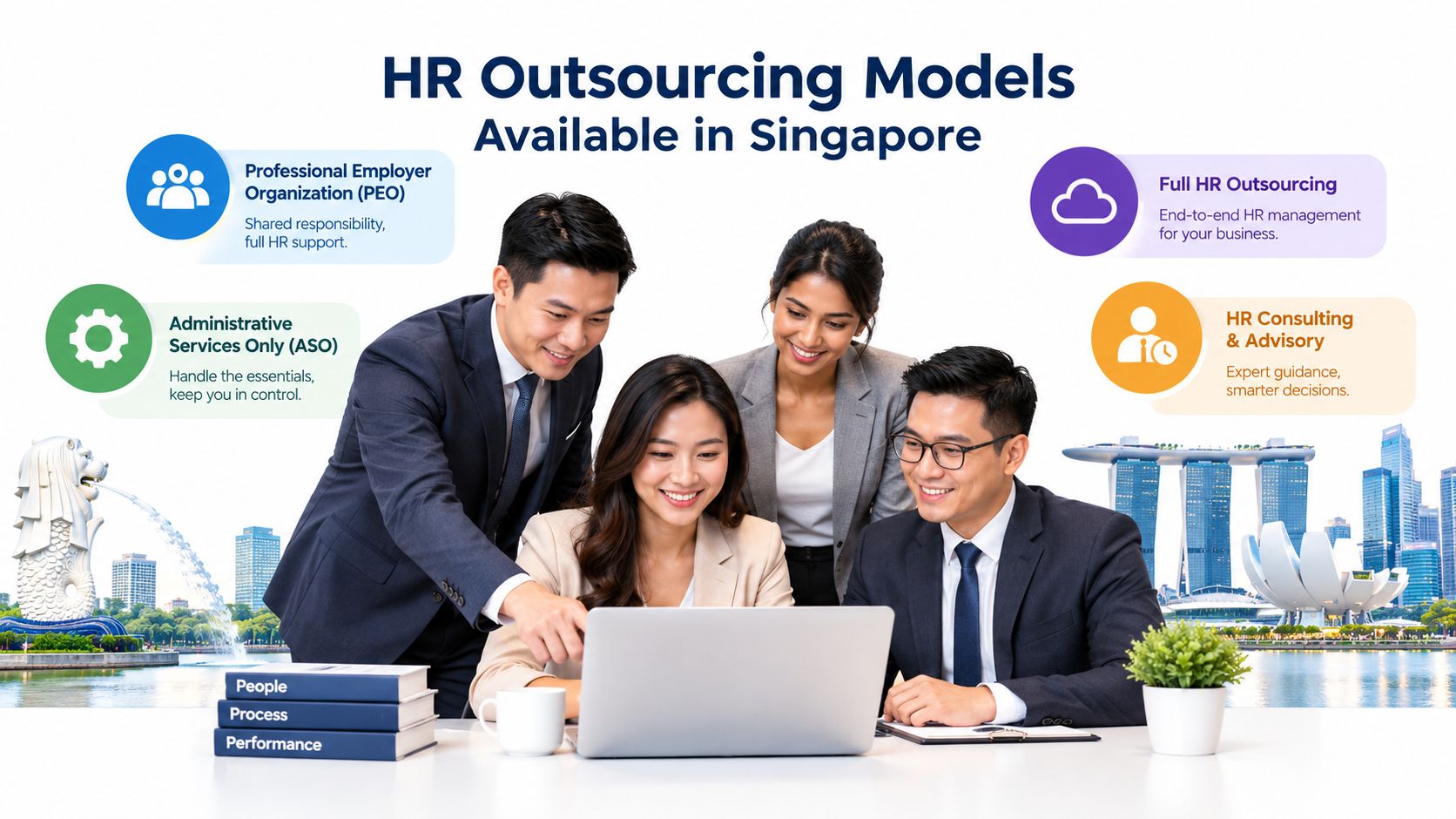
The decision is usually between four practical models, not one broad HR outsourcing label.
1. Specialist or embedded recruitment
This is the right starting point when the main problem is not administration but getting the right candidates into process.
An embedded recruitment or specialist hiring partner can help with:
- role calibration
- market mapping and sourcing
- candidate screening and fit assessment
- interview coordination
- offer-stage support and handover into onboarding
This model is usually strongest when several difficult roles are open at the same time, or when the business has no local talent-acquisition capacity. For employers comparing sustained hiring support, Recruitment Process Outsourcing Singapore is the more relevant comparison page than a general HR service page.
2. Payroll outsourcing
Payroll outsourcing is usually the right first move when the company already has hires, but monthly payroll processing depends on spreadsheets, manual checks and last-minute approvals.
A payroll partner normally supports:
- payroll calculations
- payslip preparation
- disbursement coordination
- statutory payroll administration
- payroll reports and review cycles
This model works best when the employer already controls headcount and compensation decisions, but needs a more reliable process for translating approved employee data into accurate monthly payroll. Employers evaluating that route can compare payroll outsourcing in Singapore as a dedicated service rather than treating it as a side feature of a wider HR package.
3. HR setup and administration
HR setup and administration is often the right first outsourcing priority for a new Singapore operation, or for an employer that has hired staff before building a clean HR foundation.
This usually includes:
- employment contracts and onboarding documentation
- employee records and basic HR administration
- joining workflows and change records
- support for Employment Pass and related work-pass administration
- handover into payroll and ongoing employee administration
This area is often overlooked because the business feels busy hiring, but unclear documentation and weak employee records create downstream errors in payroll, onboarding and compliance. Employers building this foundation can review Employment Pass and HR setup support in Singapore.
4. Integrated workforce support
An integrated model is useful when recruitment, onboarding, work-pass support and payroll need to operate as one coordinated workflow rather than as separate tasks.
This is often the best fit when:
- a company is entering Singapore for the first time
- local and foreign hires are being onboarded in parallel
- one internal owner is trying to coordinate several providers
- the bottleneck is no longer one function, but the handover between functions
For that situation, employers are usually better served by comparing a coordinated operating model such as Workforce LaunchPad or the broader HR outsourcing solutions page, depending on how much of the workflow needs to be built.
A Simple Decision Framework: What Should You Outsource First?
The question is not which service sounds most complete. The question is which failure point is currently slowing the business down most.
| Current Bottleneck | Outsource First | Why This Usually Comes First |
|---|---|---|
| Too few qualified candidates, slow shortlists, hiring managers stretched | Specialist / embedded recruitment | The immediate constraint is market access, sourcing and candidate evaluation |
| Employees are joining, but payroll is manual or error-prone | Payroll outsourcing | The business needs repeatable monthly controls before errors scale |
| Contracts, onboarding records, employee files or work-pass coordination are inconsistent | HR setup and administration | The operating foundation is incomplete, which creates downstream risk |
| Hiring, onboarding and payroll are all moving at once and handovers keep breaking | Integrated workforce support | The real issue is coordination across functions, not one isolated task |
When recruitment should come first
Recruitment deserves priority when:
- the role is difficult to calibrate locally
- several vacancies are open at once
- managers are spending too much time sourcing and screening
- work-pass considerations affect candidate selection early in the process
- the business lacks a local recruiter or specialist hiring capacity
MOM’s 2Q 2026 data shows that the average monthly recruitment rate eased from 1.6% in 1Q 2026 to 1.4% in 2Q 2026, while the average monthly resignation rate remained at 1.0%, according to the official MOM report PDF. For employers, that makes it more useful to measure recruitment quality and pipeline discipline than to focus only on candidate volume.
Useful recruitment metrics include:
- qualified-submission rate
- interview-to-submission conversion
- time-to-shortlist
- offer acceptance rate
- hiring-manager satisfaction
When payroll should come first
Payroll should come first when the business already has employees, but the monthly cycle is vulnerable to delay or correction.
Typical warning signs include:
- payroll inputs arrive late or in different formats
- salary, leave or allowance changes are not captured consistently
- finance is checking payroll manually at the end of each month
- there is no clear correction process when an error appears
- annual reporting depends on reconstructing data from several sources
Payroll outsourcing is not a substitute for decision-making. The employer still approves pay items and employee changes. The value is in creating a controlled and reviewable monthly process.
When HR setup should come first
HR setup should come first when the company is still building the core records and documents that support lawful employment administration.
That is usually the case when:
- a new Singapore entity is being launched
- Employment Pass applications and onboarding need coordination
- contracts and employee records are not standardised
- internal teams are unsure what information must be collected before payroll starts
- different people are handling offers, documents and onboarding with no shared workflow
This is often the right first move for overseas employers entering Singapore. If the basics are not built clearly, recruitment success simply feeds a weak administrative process.
When an integrated model makes sense first
Sometimes the bottleneck is not recruitment, payroll or HR setup in isolation. It is the break between them.
An integrated model is usually justified when:
- hiring volume is increasing across several roles
- both local and foreign employees are being onboarded
- work-pass documentation, onboarding and payroll data need one shared process
- leadership wants one accountable workflow rather than multiple disconnected vendors
In those cases, it is more practical to build one operating flow from approved role to employed and paid team member than to outsource each task separately.
A Brief Comparison of the Models
| Model | Core Strength | Best First Use Case | Main Risk if Chosen Too Early |
|---|---|---|---|
| Specialist / embedded recruitment | Sourcing, calibration and candidate assessment | Scarce roles or sustained hiring pressure | It will not fix weak onboarding or payroll controls |
| Payroll outsourcing | Accuracy, repeatability and monthly control | Existing team needs dependable payroll administration | It will not solve poor employee records or role scarcity |
| HR setup and administration | Contracts, records, onboarding and process foundation | New entity or underdeveloped HR operations | It may feel too administrative if hiring is the urgent issue |
| Integrated workforce support | Coordination across recruitment, setup and payroll | Singapore entry or multi-function scaling | It can be broader than necessary if only one function is failing |
Some employers also compare administrative employment models such as PEO-style arrangements. These should be treated carefully and only as a separate structural comparison, not as a default answer to specialist recruitment, payroll or HR setup needs. They should not be viewed as a workaround for Singapore work-pass requirements, which remain subject to the applicable legal and regulatory rules.
Compliance Realities Still Matter After Outsourcing
Outsourcing changes who processes the work. It does not remove employer accountability.
CPF requires employee-level payroll controls
For Singapore Citizens and Singapore Permanent Residents earning more than S$50 in total wages per month, employers must pay CPF contributions under the applicable rules in the CPF Board’s employer guidance.
From 1 January 2026, the Ordinary Wage ceiling is S$8,000 per month, according to the official CPF Board explanation of the OW ceiling. Full contribution rates for eligible private-sector employees and non-pensionable government employees are set out in the official CPF contribution rate tables. The full rates listed below apply to Singapore Citizens and to Singapore Permanent Residents from their third year onwards, where monthly wages exceed S$750. First and second year SPR contribution rates differ:
- 55 and below: employer 17%, employee 20%
- Above 55 to 60: employer 16%, employee 18%
- Above 60 to 65: employer 12.5%, employee 12.5%
- Above 65 to 70: employer 9%, employee 7.5%
- Above 70: employer 7.5%, employee 5%
That is one reason payroll outsourcing should include review controls and exception reporting, not just payslip generation.
Data-processing responsibilities should be explicit
When a payroll or HR provider processes personal data on behalf of an employer, it will often act as a data intermediary under Singapore’s PDPA framework. The PDPC guide to managing data intermediaries and the PDPC guide on data protection clauses for processing agreements make clear why contracts should define:
- the scope of permitted processing
- access and security controls
- retention and deletion requirements
- breach notification and escalation
- subcontracting and oversight arrangements
This matters for outsourced payroll, candidate handling and employee administration alike.
IRAS annual reporting still needs a named owner
Employers participating in the Auto-Inclusion Scheme must submit employees’ employment income information electronically to IRAS by 1 March each year. IRAS states that failure to file by the deadline may result in a fine of up to S$5,000, as noted in its official AIS enforcement update on Auto-Inclusion Scheme non-compliance.
Whether payroll is outsourced or not, the process still needs a named owner to reconcile payroll records, taxable remuneration and employee particulars before submission.
How to Make the Decision Practically
If you are deciding what to outsource first, ask these four questions in order:
-
What breaks first each month or each hiring cycle?
If candidate flow is weak, start with recruitment. If payroll reviews are unstable, start with payroll. If onboarding records and work-pass coordination are fragmented, start with HR setup. -
What capability does the business genuinely not have in-house?
Outsourcing works best when it fills a missing capability, not when it duplicates a functioning one. -
Where do errors create the greatest business risk?
A delayed shortlist slows growth. A payroll error affects employees directly. Weak HR setup creates repeat problems across onboarding, compliance and payroll handover. -
Do you have one bottleneck or several broken handovers?
One bottleneck points to a focused service. Repeated handover failures point to integrated support.
Final View
This article should help answer a narrower question than a general HR outsourcing guide. The right starting point is usually not “outsource HR”. It is identify the function that is currently constraining growth or control, then outsource that first.
- Choose specialist or embedded recruitment when the business cannot generate qualified hiring pipelines fast enough.
- Choose payroll outsourcing when employees are already in place and the monthly control process is under strain.
- Choose HR setup and administration when the company needs proper contracts, records, onboarding and work-pass coordination.
- Choose integrated workforce support when the real problem is the connection between those functions.
For Singapore employers who want to assess that choice in a practical way, PathSource offers HR outsourcing solutions, payroll outsourcing support, recruitment process outsourcing, Employment Pass and HR setup support, and coordinated launch support through Workforce LaunchPad.